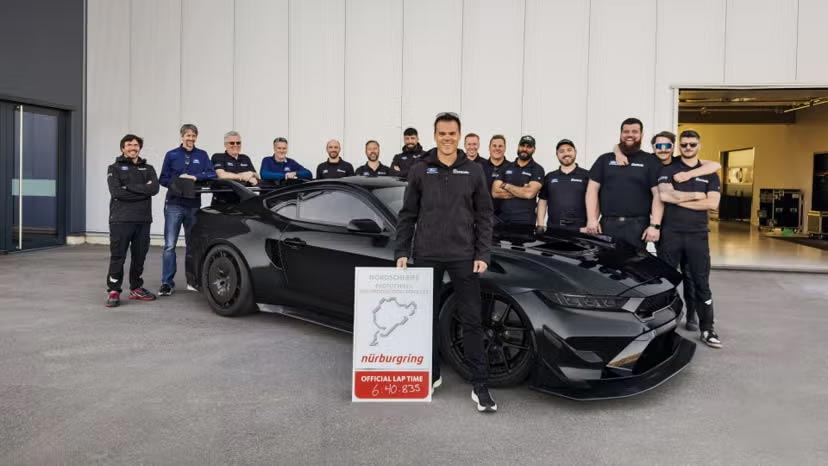
Ford has announced a new Mustang GTD Competition variant with more power, revised aero, grippier tires, and weight-reduction measures such as magnesium wheels and carbon bucket seats. The GTDC recorded a Nürburgring lap of 6:40.8, setting a new American production car record and placing second-fastest overall behind the Mercedes-AMG One. The article frames the move as a prestige and performance push versus Chevrolet's Corvette ZR1/ZR1X, but it is not material enough to imply a major near-term market impact.
Ford’s latest Nürburgring push looks less like a demand-led product cycle and more like a brand-defense campaign against a rival that has mathematically changed the benchmark for American halo cars. That matters because halo programs are rarely P&L movers on unit economics alone; they function as margin-supporting traffic generators for the broader lineup, so losing the performance narrative can leak into Mustang showroom mix, dealer enthusiasm, and even residual values on prior special editions over the next 6-18 months. The second-order effect is on capital allocation credibility. A costly escalation into low-volume performance variants signals management is willing to spend engineering and marketing dollars to protect prestige, but the incremental return is questionable if the underlying vehicle is structurally outgunned on power, price, and usability. If Ford keeps chasing lap-time headlines without a cleaner product story, the market may start valuing these programs as vanity spend rather than disciplined brand investment, which is a subtle negative for the multiple if investors begin to see a pattern. The contrarian read is that Ford may not be trying to “win” versus the Corvette at all; it may be monetizing the loss by stretching the lifecycle of the GTD platform and extracting scarcity value from a motivated enthusiast base. In that framework, the announcement cadence itself is the product, and the record attempts are designed to preserve pricing power on special trims rather than drive volume. That suggests the downside to Ford is less about near-term earnings and more about reputational erosion if the next reveal disappoints or if the competition keeps widening the performance gap. For Hagerty, this kind of escalating halo-war content is mildly supportive because it reinforces collector-car relevance and auction-side storytelling around limited-production performance vehicles. Lucid is mostly a bystander here, but the broader takeaway for EV/performance comparables is that benchmark-setting becomes increasingly important for aspirational branding, not just efficiency. The real risk is that the performance-technology arms race shifts consumer expectations upward, making expensive low-volume launches less impressive unless they also deliver unmistakable day-to-day usability.
AI-powered research, real-time alerts, and portfolio analytics for institutional investors.
Request DemoOverall Sentiment
neutral
Sentiment Score
0.15
Ticker Sentiment
