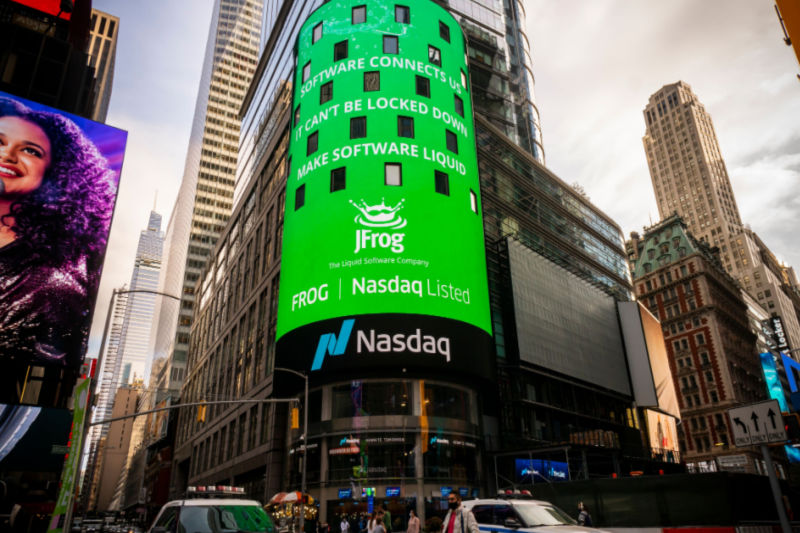
CEO Shlomi Ben Haim sold 25,000 JFrog shares for $1.13M at $45.00–45.35, leaving him with 4,765,249 shares; the sale was executed under a Rule 10b5-1 plan. JFrog (market cap $5.22B) shows strong fundamentals (76.79% gross margin, cash > debt) but is flagged as overvalued by InvestingPro; UBS upgraded to Buy with a $60 target, while TD Cowen and Guggenheim reiterated Buy ($80 and $60). The company launched a JFrog Agent Skills Registry integrated with NVIDIA to support AI agents, but faces a recent supply-chain attack via the Python package litellm that compromised cloud/infrastructure credentials.
JFrog sits at an inflection where enterprise demand for AI agent governance and artifact registries can expand its average contract value (ACV) beyond developer tooling into platform-level security and compliance. If even 5-10% of large-cloud customers standardize on a governed skills/agent registry, that could lift subscription ARR growth and upsell rates materially over 12–24 months, improving gross-to-operating leverage given its ~75% gross margins.
The recent supply-chain compromise creates an asymmetric near-term story: it raises the floor for spend on secure registries and provenance (benefit), but also increases procurement friction—large buyers may favour cloud-provider managed registries or single-vendor stacks to reduce operational risk, which would cap long-term TAM capture and compress renewal rates. Expect a bifurcation where mid-market adopters accelerate on third-party registries while hyperscalers internalize.
Analyst upgrades reflect a rerating on 12–18 month optionality from AI governance, not necessarily a durable valuation uplift; the stock is sensitive to cadence of enterprise pilot wins, two-quarters of consistent net-new ACV growth, or another publicized supply-chain incident. Insider 10b5-1 activity reduces signalling power short-term, so price action will be driven more by product traction and macro risk appetite than insider flows.
Practical positioning should be asymmetric: own optionality to enterprise AI governance adoption while protecting downside to episodic security headlines. Trades should target catalysts (NVDA integrations, enterprise pilot announcements, quarterly ARR cadence) over 3–12 month windows and size conviction relative to binary security risk that can create 20–40% headline-driven drawdowns.
AI-powered research, real-time alerts, and portfolio analytics for institutional investors.
Request DemoOverall Sentiment
mixed
Sentiment Score
0.05
Ticker Sentiment
