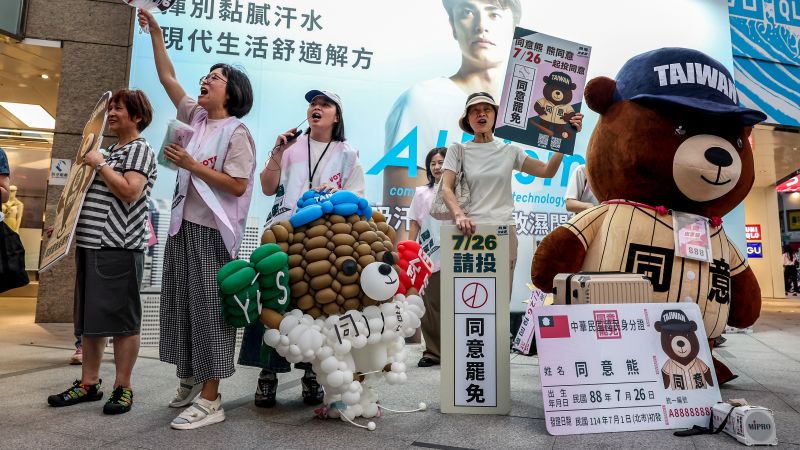
Taiwan is currently experiencing an unprecedented series of recall votes targeting 24 opposition Kuomintang (KMT) lawmakers, a move supported by President Lai Ching-te's ruling Democratic Progressive Party (DPP). The outcome is pivotal as a successful recall could enable the DPP to regain a legislative majority, empowering President Lai to advance his policy agenda, including increased defense spending and strengthening ties with the United States amidst escalating Chinese pressure. Conversely, a failed recall effort would weaken Lai's administration and bolster the KMT, potentially impacting Taiwan's geopolitical alignment and its relationship with both the US and China.
Taiwan is facing a period of significant political uncertainty centered on an unprecedented recall vote targeting 24 opposition Kuomintang (KMT) lawmakers. The outcome of this vote is pivotal, as it could shift the balance of power within the legislature, which is currently a key obstacle for President Lai Ching-te's ruling Democratic Progressive Party (DPP). The DPP, which lacks a majority with only 51 of 113 seats, could regain control if the recalls are successful, empowering President Lai to break the current political gridlock. This would have direct implications for fiscal and foreign policy, most notably enabling the administration's plan to increase defense spending from 2.5% to over 3% of GDP. Such a move is framed as critical for strengthening ties with the United States, particularly under a potentially transactional Trump administration, and for countering escalating military pressure from China. Conversely, a failure to oust the KMT lawmakers would entrench the current legislative paralysis, weakening President Lai's position both domestically and internationally, and likely complicating efforts to advance security and economic policies favored by Washington.
AI-powered research, real-time alerts, and portfolio analytics for institutional investors.
Overall Sentiment
Neutral
Sentiment Score
0.00
