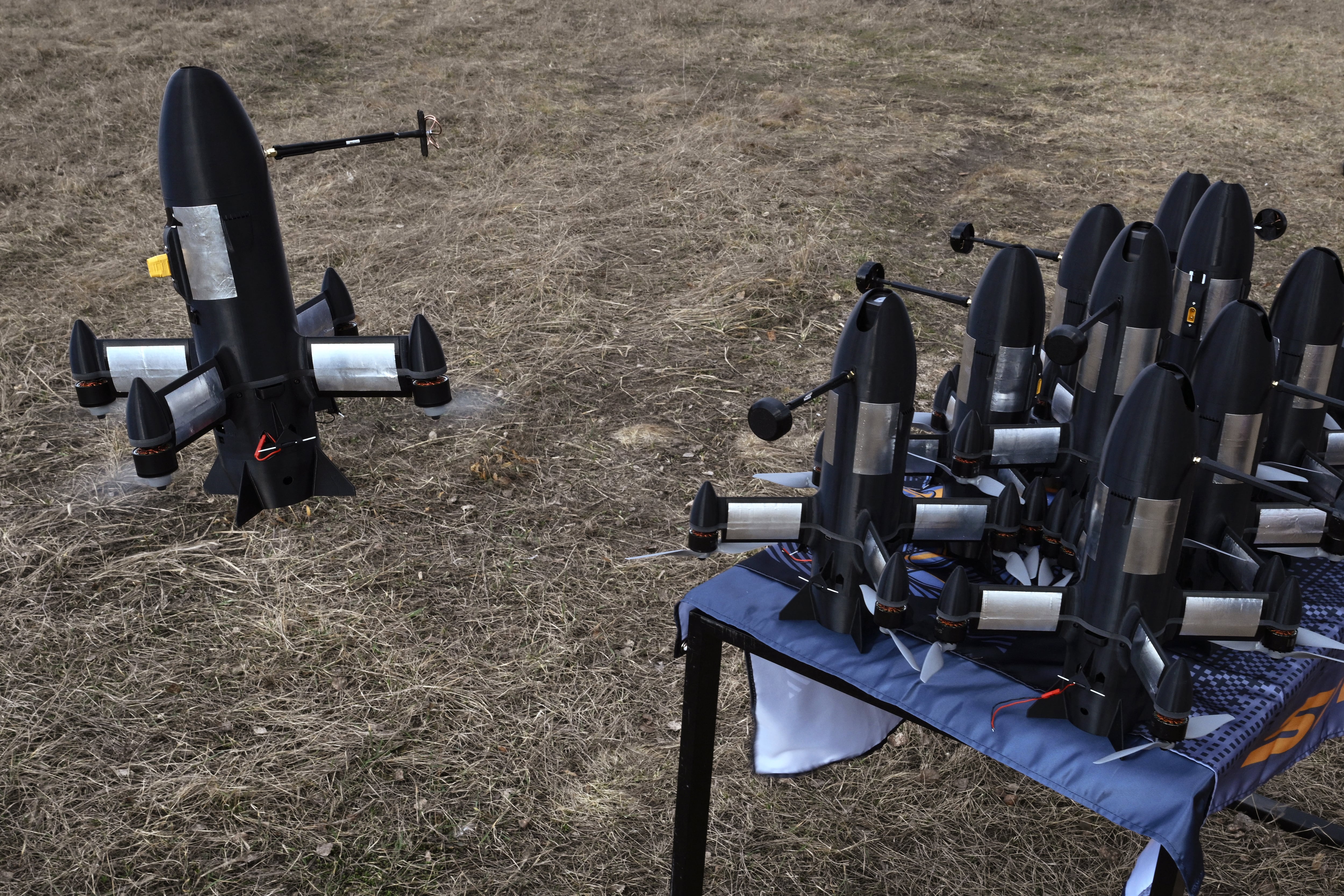
Ukraine currently produces ~1,000 interceptor drones per day and claims technical capacity to double output but lacks budget, highlighting a logistics and sustainment gap. Commercial entrants offer portable production hubs (e.g., Sensofusion’s $2.4M container producing up to 50/day with interceptors <$580 each; Firestorm Labs produces ~50/month, has a $100M USAF contract and $47M Series A; Per Se’s trailer unit can make ~10/hour). Key risks: field survivability of containerized factories, supply-chain reliance for motors/batteries/electronics, quality control in austere conditions, and export/approval issues—NATO and allies (LEAP) are racing to address capability shortfalls.
The market will bifurcate between endpoint hardware makers and integrated sustainment/infrastructure providers; long-term economic value will accrue to firms that own the sensor-to-effector integration, logistics, and quality-control layers rather than vendors flogging hardware boxes. Expect procurement programs and military budgets to favor incumbents with field-proven integration playbooks — a win for systems integrators and contract manufacturers — while pure-play “portable factory” vendors face adoption friction from hard-to-solve component sourcing and ruggedization challenges.
A surge in demand for motors, ESCs, RF modules, and rugged battery chemistries is a non-linear supply-shock risk: these are not 3D-printable bottlenecks and will impose multi-quarter lead times on new production lines, supporting pricing power for select semiconductor and battery suppliers. Component shortages will amplify value capture upstream (semis, power electronics) and for consolidators who can guarantee vetted supply chains and qualification processes.
Key catalysts to watch in the next 3–18 months are: NATO procurement award milestones, publicized failures or captures of deployed production units (which would trigger rapid export-control responses), and field demonstrations proving sustained high-throughput production under combat conditions. Any one of these can re-rate winners/losers quickly.
Contrarian angle: the market’s excitement about turnkey containerized factories underprices asymmetric operational risk — capture, IP exposure, and degraded field QC — while underestimating the moat created by years of real-combat iteration. Capital should prefer durable integrators and component suppliers over hype-driven hardware vendors.
AI-powered research, real-time alerts, and portfolio analytics for institutional investors.
Request DemoOverall Sentiment
mixed
Sentiment Score
0.05
