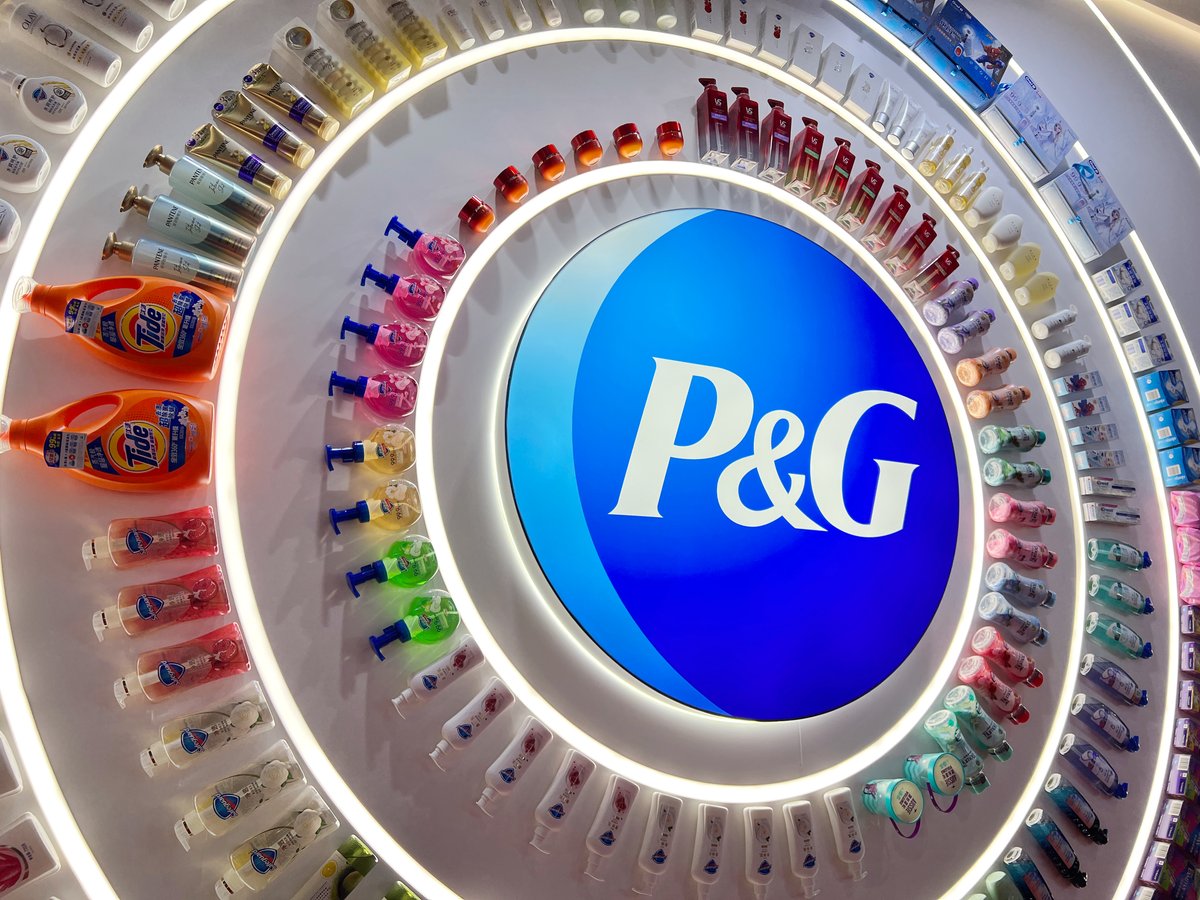
Procter & Gamble has materially underperformed growth markets, returning roughly $1 for every $5 of S&P 500 gains over 2020–2024 and is down nearly 10% year-to-date with staples the second-worst S&P 500 sector as of end-Q3. The company remains a reliable dividend payer — 135 years of payouts and 69 consecutive annual increases — guiding 4–6% annual dividend growth; fiscal 2025 EPS was $6.51 versus a $4.48 per-share dividend and operating/free cash flow surged in Q3, supporting sustainability. The piece frames P&G as a defensive, income-oriented holding suitable for lower-risk portfolios while noting investor preference for AI and growth stocks has hurt staples’ relative performance.
Market structure: Capital has rotated from low-volatility staples into AI/growth, leaving P&G (down ~10% YTD) and the sector structurally underowned despite stable end-demand. Over 2020–24 the article notes P&G returned $1 for every $5 of the S&P, and aggregate bond funds have outperformed staples over three years — indicating investor demand, not product demand, is the primary driver. That creates a bifurcated market where consumer cash flows (sales, FCF) are steady while equity flows are away, compressing P&G’s valuation multiple even as pricing power persists in branded SKUs.
Risk assessment: Key tail risks are commodity-cost shock (pulp/palm/petrochemical), intensified private-label gains, or an operational supply-shock in Asia — any could compress FY26 EPS by >20%. Time horizons matter: immediate (days) technical selling can add 5–10% volatility, short-term (weeks–months) earnings/guidance can move stock ±10% around prints, long-term (quarters–years) dividend sustainability looks reasonable with FY25 EPS $6.51 vs dividends $4.48 (payout ~69%). Hidden dependencies include FX exposure and retailer trade promotions; catalysts to reverse trends are Fed rate cuts, a CPI drop below 3% (H2 2025 target), or activist/share-buyback acceleration.
Trade implications: For income-oriented capital, P&G is a reliable dividend cash machine — consider small core allocation rather than growth exposure. For relative-value traders, the structural investor outflow creates opportunities for pair trades (long secular growth or cyclicals vs short PG) and income-enhancing option overlays (covered calls or put protection) while monitoring payout ratio and quarterly cash flow. Cross-asset: expect modest safe-haven demand into IG bonds (AGG) if staples underperform persists and elevated implied vol in staples options for tactical hedges.
Contrarian angles: The market may be over-penalizing a company with 135 years of dividends; a 4–6% dividend-growth guide with stable FCF implies downside capped absent macro shock, so mean-reversion is plausible when rate/PIE multiple normalizes. Historical parallels (2022 defensive re-rate) suggest staples can re-rate quickly on macro shocks — if CPI falls to <3% or 10y yields drop >50bps, expect a 10–20% valuation bounce within 3–12 months. The risk: crowding into 'safe' dividends if rates fall could leave little upside absent operational improvement, so size positions to income objectives, not growth targets.
AI-powered research, real-time alerts, and portfolio analytics for institutional investors.
Request DemoOverall Sentiment
moderately negative
Sentiment Score
-0.40
Ticker Sentiment
