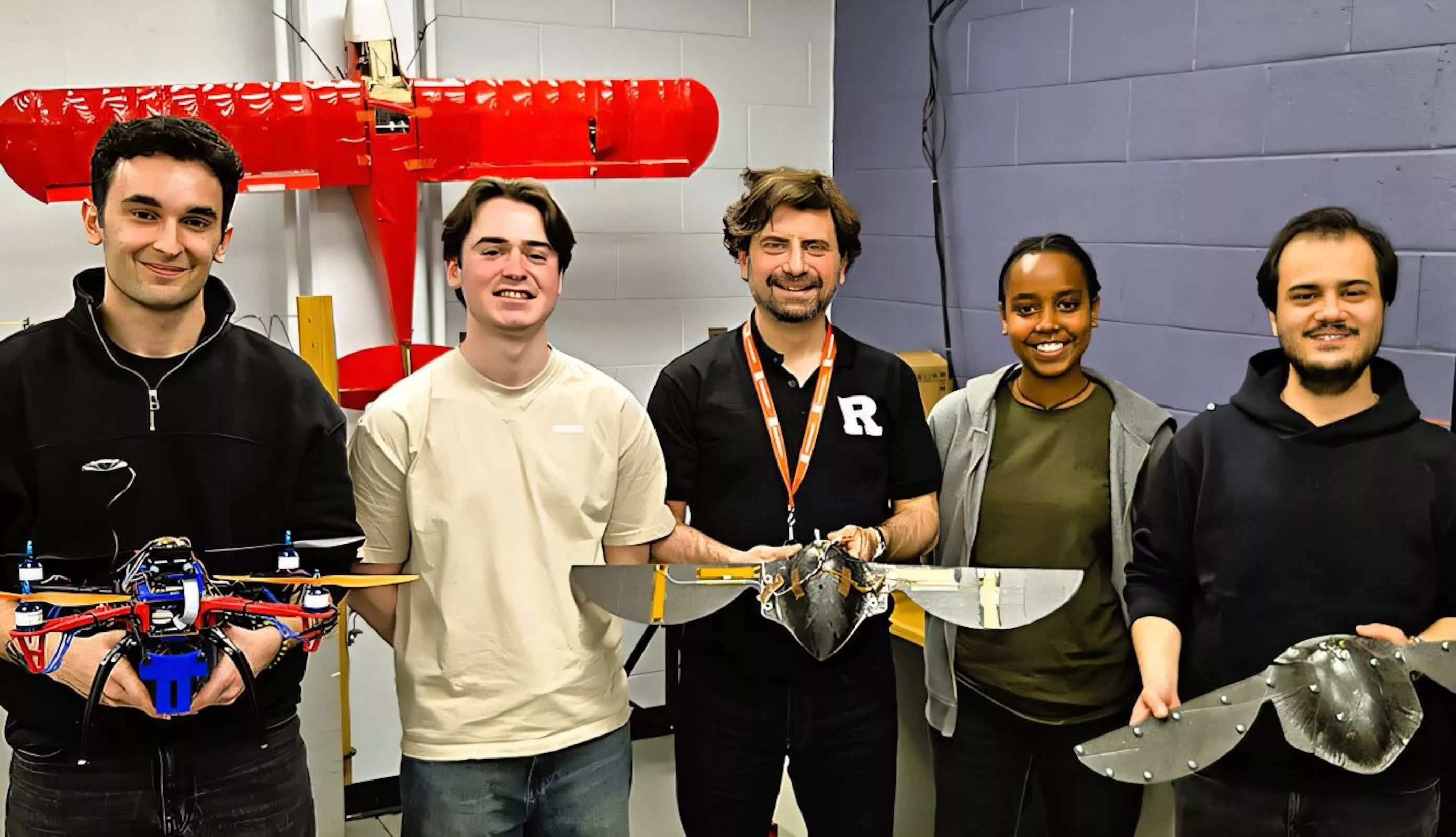
Key event: Rutgers engineers published research in Aerospace Science and Technology demonstrating a 'solid-state ornithopter' that achieves flapping flight without motors, gears, or linkages by embedding piezoelectric Macro Fiber Composites on flexible carbon-fiber wings. The team validated feasibility via computational models and a prototype that deforms under applied voltage, but noted current piezoelectric materials lack sufficient performance for full realization. Potential applications include agile drones for environmental monitoring, search-and-rescue, urban delivery and morphing turbine blades to improve wind energy capture; commercial impact remains limited until materials improve.
Winners are likely to be specialty materials and precision-manufacturing suppliers rather than established airframe OEMs: think high-end carbon-fiber laminators, macro-fiber/piezo ceramic producers, precision adhesives, and the niche power-electronics firms that can drive high-voltage, high-frequency control at low mass. Second-order beneficiaries include autonomous-control software firms and sensor integrators because materially-driven morphing reduces mechanical complexity but increases requirements for closed-loop sensing and real‑time control. Legacy actuator and gearbox suppliers face slow erosion of certain low-margin markets, but the replacement curve will be governed more by materials readiness and certification timelines than by immediate commercial substitution.
The single biggest tail risk is materials: absent a step-change (30–100% improvement) in strain-to-voltage or energy density from current piezo ceramics, the concept remains a lab curiosity — expect a 3–7 year commercialization runway under optimistic R&D paths and a 7–10+ year window for broad industrial adoption (turbines, urban delivery). Manufacturing bottlenecks (autoclave throughput, precision layup yields) and durability (fatigue life over thousands of cycles in harsh environments) are near-term gating factors; conversely, a credible breakthrough in piezo materials or scalable MFC production within 12–24 months would compress that timeline materially. Regulatory and certification friction for manned/urban airspace is a separate multi-year drag that could shift adoption to niche inspection and renewables first.
The most actionable market opportunity is an upstream play on materials and retrofitable systems: if even one large turbine OEM adopts morphing blade patches for load control, addressable aftermarket spend for sensors, actuators, and composites could reach low-single-digit billions annually within five years. ESG and supply-chain dynamics create another angle — lead-containing piezo formulations and carbon-fiber recycling constraints create premiums for low-lead piezo suppliers and recyclable/thermoplastic composites, opening a differentiated moat for early entrants.
From a portfolio perspective, size exposure small-to-moderate and hedge technology risk explicitly; treat early positions as asymmetric optionality—limited capital for potentially >30–40% upside if materials and certification accelerate, but with a plausible scenario of capital rewrite to zero if material performance fails to improve. Monitor three catalysts: vetted materials-performance papers/patents, a large OEM test announcement, and certification milestones for unmanned urban flight.
AI-powered research, real-time alerts, and portfolio analytics for institutional investors.
Request DemoOverall Sentiment
mildly positive
Sentiment Score
0.15
