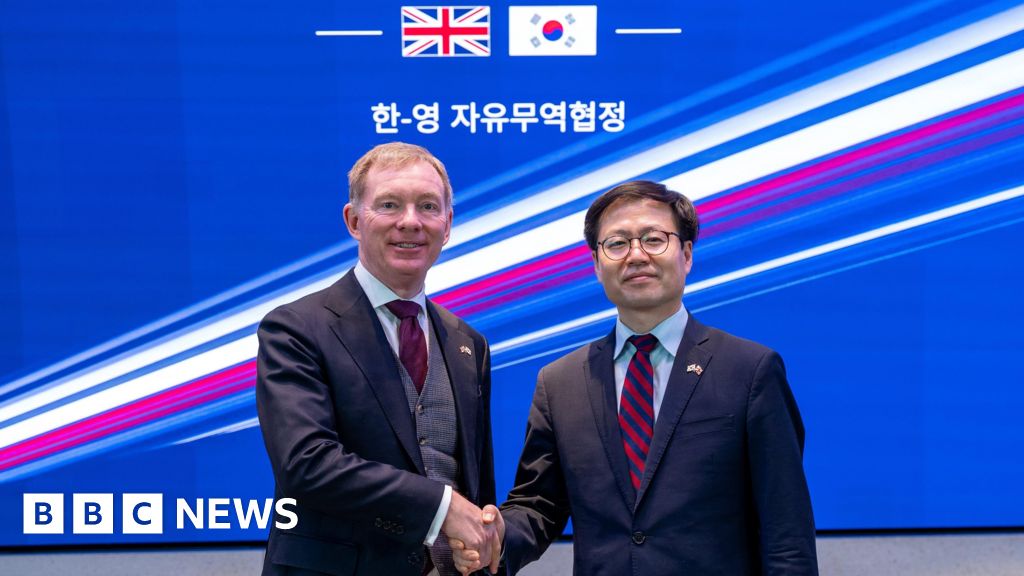
The UK and South Korea have finalised a trade agreement preserving 98% tariff-free access—matching EU terms—and protecting about £2bn of UK exports from tariff increases, with beneficiaries including pharmaceuticals, automotive, alcohol and financial services; the deal also targets non-tariff barriers by easing rules of origin and adding digital and investment protections. Announced by Trade Minister Chris Bryant alongside South Korea’s Yeo Han-koo, ministers framed the pact as a jobs- and growth-supporting move and as a gateway for each country into Europe and Asia, while industry players from Bentley to Diageo and the Scotch Whisky Association welcomed improved market access. The deal is the Labour government’s fourth post‑Brexit trade pact, but broader economic impact is uncertain—South Korea accounts for just 0.8% of UK trade and recent bilateral trade has fallen, and the OBR has previously judged similar deals unlikely to produce a measurable GDP boost by 2030.
The UK and South Korea finalised a trade agreement that preserves 98% tariff‑free access—matching the EU terms—and explicitly protects about £2bn of UK exports from tariff increases, averting expiry of prior arrangements due in January 2026; ministers announced the deal at Samsung's London store and identified beneficiaries including pharmaceuticals, automotive, alcohol and financial services.
Bilateral trade is economically small: South Korea is the UK's 25th largest trading partner, accounting for 0.8% of UK trade in the 12 months to June, and bilateral flows have recently fallen (UK exports to Korea down 16.4%, Korean exports to the UK down 10.8%). Prior post‑Brexit deals have not produced measurable GDP gains to date and the OBR expects limited macro impact through 2030; the government's own assessment of the India deal estimated a GDP uplift of only 0.11–0.14%.
The pact targets non‑tariff barriers—rules of origin, digital and investment protections—which should reduce frictions for exporters and services and offer targeted corporate upside (Bentley, JLR, Diageo and Scotch Whisky Association signalled support). Market sentiment is mildly positive with a modest market‑impact score, implying benefits will be incremental and implementation and trade‑flow recovery are the likeliest near‑term catalysts; key risk is that gains remain dispersed and slow to materialise.
AI-powered research, real-time alerts, and portfolio analytics for institutional investors.
Request DemoOverall Sentiment
mildly positive
Sentiment Score
0.25
Ticker Sentiment
