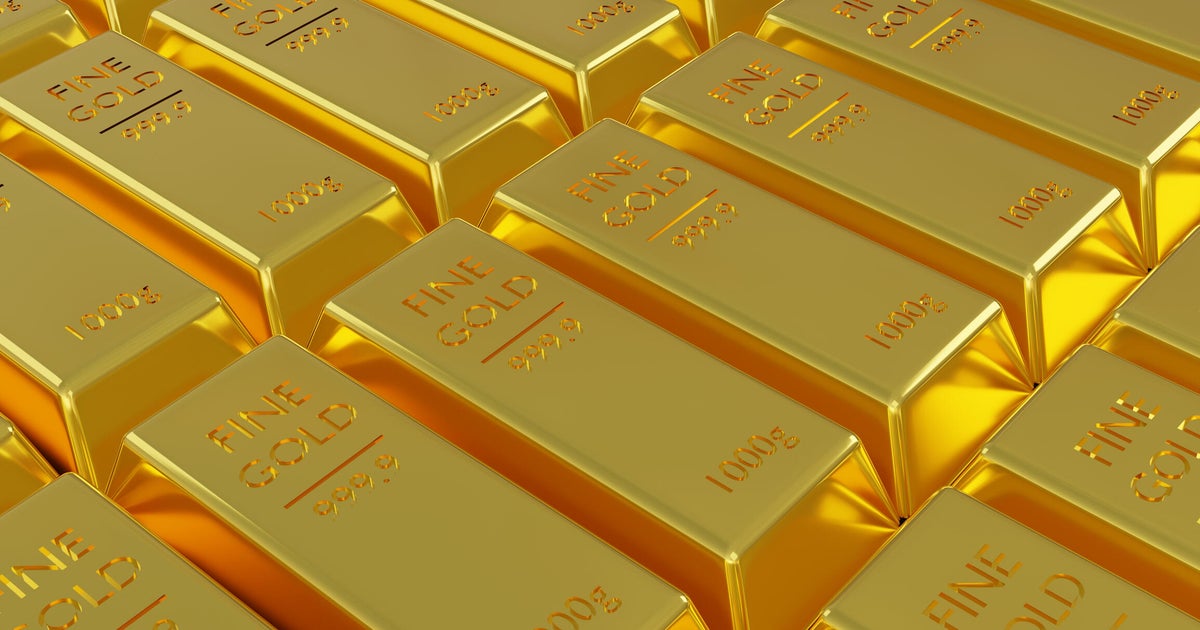
Gold prices have surged to a record high of over $4,000 an ounce, marking a 53% year-to-date gain, driven by a confluence of factors signaling growing investor unease. This rally is attributed to heightened U.S. economic and political uncertainty, including the government shutdown and tariffs, coupled with expectations of Federal Reserve rate cuts making gold more attractive relative to lower-yielding bonds. Additionally, strong demand from global central banks seeking to reduce dollar exposure amid geopolitical tensions, particularly since 2022, is providing a robust foundation for prices, with analysts forecasting further appreciation towards $4,200/oz and potentially $4,900/oz by 2026.
Here's what gold crossing $4,000 is telling us about the U.S. economy Gold is glittering for investors, with prices now topping a record $4,000 an ounce. But the reasons behind the shiny metal's surge may be less than dazzling, with Wall Street analysts saying it reflects growing unease over the U.S. economy and political stability. The price of gold has leaped 53% this year alone, far outpacing the 15% gain in the S&P 500 stock index over the same period. The price of an ounce of gold edged higher on Wednesday, touching $4,078, according to financial data company FactSet, with some analysts predicting it to go higher. Investors have long turned to gold during periods of economic turmoil and high inflation, viewing it as both a safe haven when markets turn volatile and a hedge against rising prices. Of late, however, stock prices have steamed to record highs this year, economic growth has accelerated in recent months and inflation this year has remained relatively subdued, prompting questions about what's fueling investors' renewed appetite for gold. "$4,000 an ounce seemed far-fetched at the start of the year as gold entered 2025 near $2,800 an ounce. But after a ~50% rally, here we are," eToro U.S. investment analyst Bret Kenwell said in an email. The reasons for the surge boil down to several economic and political factors, according to Kenwell and other investment analysts. Economic uncertainty Gold is often a refuge for investors when they're worried about the economy, and the ongoing U.S. government shutdown is only fueling their anxieties, according to Nigel Green, CEO of investment firm deVere Group. "The situation in Washington has reminded investors that political promises do not equate to financial security. Gold represents protection from that uncertainty, but its price now also reflects how much faith has drained from other assets. That level of dependence always carries risk," Green said in an email. Although the economy continues to expand, investors are also expressing concern about potential headwinds to growth, including the impact of U.S. tariffs and a weakening job market, according to economists. Federal agencies currently aren't releasing economic data due to the government shutdown, now in its second week. That makes it more difficult to get a handle on the state of the economy, said Kevin Ford, FX and macro strategist at Convera. "[T]he US economy remains a challenge to read due to the ongoing government shutdown, which has severely diminished visibility," Ford noted. "However, the shutdown is a material headwind: S&P Global Ratings estimates it could trim GDP growth by 0.1−0.2 percentage point for every week the government remains closed." Fed rate cuts In September, the Federal Reserve lowered its benchmark interest rate for the first time since late 2024 and signaled that two more cuts could be in the cards later this year. Gold has risen partly due to investor expectations that the Fed is entering a cycle of easing its monetary policy, according to Bart Melek, head of commodity strategy at TD Securities. With interest rates seemingly heading lower, gold is more attractive as a financial asset because investors aren't losing out on higher yields from Treasuries and other government bonds, he told investors in a report. And with inflation drifting up due to the impact of the Trump administration's tariffs, gold can also continue to offer an inflation hedge. Gold "may be a better safe-haven than Treasuries," Melek wrote. "Add to that the fact that ore grades are dropping, the increased use of these factors of production suggests that gold would be better at protecting purchasing power." Global gold demand Investments in gold have also been driven by other factors. Analysts point to strong gold demand from central banks around the world amid heightened geopolitical tensions, such as the ongoing wars in Gaza and Ukraine. "The gold rally started in 2022," Giovanni Staunovo, commodity analyst at UBS Global Wealth Management, said via email on Tuesday. The "trigger point" for the increase was when the U.S. and other Western allies moved to freeze around $300 billion of Russian foreign holdings at the beginning of the war in Ukraine, he added. Central banks in other nations are "the quiet force behind this climb," deVere's Green said. "They are buying close to one thousand [tons] of gold each year to reduce exposure to the dollar and to reinforce their financial resilience. When official institutions keep accumulating at this rate, they create a strong foundation beneath the market, but even that has limits." Where could gold go from here? Some investment pros think gold has more room to run, pointing to ongoing economic challenges such as the slowing U.S. job market and rising inflation, as well as the Fed likely continuing to push down borrowing costs. "We think the rally is not yet done — we expect prices to rise to $4,200/oz over the coming months — and keep our 'attractive' rating on gold in our global strategy," Ulrike Hoffmann-Burchardi, CIO Americas and global head of equities at UBS Global Wealth Management, told investors in an email. Goldman Sachs is forecasting that gold could hit $4,900 an ounce by December 2026, Reuters reported. Still, experts urge average investors not to put all their eggs in one basket. Critics say gold isn't always the inflation hedge many claim and that there are more efficient ways to protect against potential loss of capital, such as derivative-based investments. "Gold is perceived by many market participants as a safe-haven asset. But investors need to be aware it has a volatility of 10-15%," Staunovo noted. He added that smaller amounts of physical gold, such as gold coins or 1-gram bars, have larger ranges between buying and selling prices. Gold prices have surged to a record high of over $4,000 per ounce, reflecting a significant 53% year-to-date gain that substantially outperforms the S&P 500's 15% return over the same period. This rally is primarily driven by growing investor apprehension regarding U.S. economic and political stability, evidenced by the ongoing government shutdown impacting economic data visibility and concerns over tariffs and a weakening job market. The sentiment is mixed, with an uncertain tone, despite the strong price action. Expectations of Federal Reserve rate cuts, initiated in September 2024, are making gold more attractive by reducing the opportunity cost of holding non-yielding assets compared to lower-yielding Treasuries. Concurrently, strong and consistent demand from global central banks, particularly since the 2022 freezing of Russian foreign holdings, provides a robust foundational bid for gold as nations seek to diversify away from the U.S. dollar amid heightened geopolitical tensions. Analysts from UBS and Goldman Sachs project further upside, with near-term targets of $4,200/oz and a potential reach of $4,900/oz by December 2026. However, investors are cautioned regarding gold's typical 10-15% volatility and its limitations as a sole inflation hedge, with some experts suggesting derivative-based alternatives for capital protection. This highlights the nuanced nature of gold's current role.
AI-powered research, real-time alerts, and portfolio analytics for institutional investors.
Request DemoOverall Sentiment
mixed
Sentiment Score
-0.25
Ticker Sentiment
