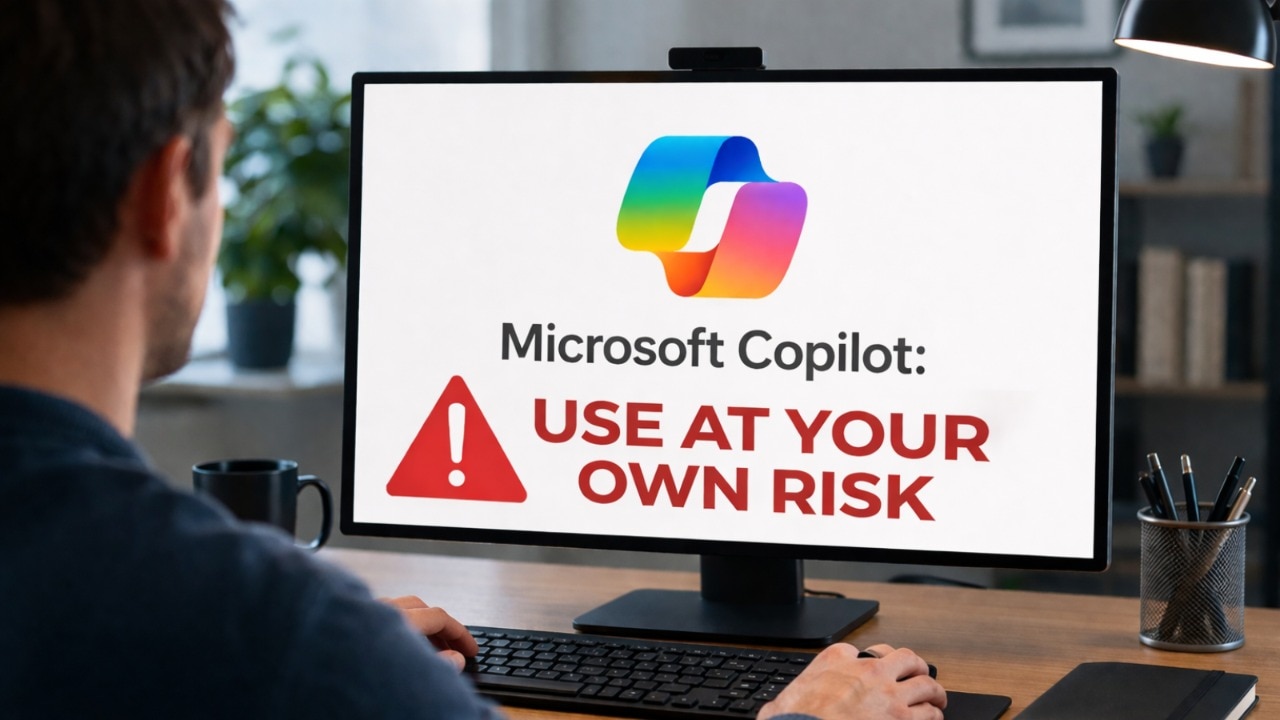
Microsoft updated Copilot's terms (changed in October) to label the product 'entertainment purposes only' and warn users to 'use at your own risk', effectively shifting liability for inaccuracies. The move acknowledges LLM hallucination risk while Microsoft continues to push Copilot commercially — the firm has ~78 Copilot-branded products and only 3% of customers were paying for Copilot as of Dec 31, 2025. Microsoft is still expanding the product line (e.g., Copilot Cowork built on Anthropic) and urging users to fact-check outputs rather than treating Copilot as a decision-maker.
Microsoft’s legal posture shift is a classic de-risking move that changes incentives across the enterprise procurement stack: customers will demand stronger SLAs, indemnities, and human-in-loop controls before embedding generative features into core workflows. That increases near-term friction on deal velocity for premium Copilot deployments, but simultaneously raises demand for verification, audit-logging, and compliance hooks — areas where Azure platform services and third‑party MLOps vendors capture incremental spend per seat.
Near-term market reaction will be about sentiment and guidance visibility (days–weeks); the asymmetric operational risk plays out over quarters as procurement cycles and renewals reprice AI add‑ons. Tail risks include litigation or regulatory precedents that force contractual liability back onto vendors (months–years), which would materially raise customer acquisition costs and compress long‑run gross margins on AI products unless Microsoft buys insurance/changes pricing.
Secondary beneficiaries: vendors that sell model governance, monitoring, and human-review tooling (audit logs, provenance) should see 20–40% faster enterprise uptake versus generic model access, while pure-play IT outsourcers face margin pressure unless they re-skill into verification services. Competitive positioning shifts subtly: cloud infra that can offer verifiable, disciplined ML deployments (Azure, AWS) gains share versus lightweight consumer‑grade offerings from smaller AI vendors that lack enterprise controls.
Actionable inference: this is not an existential product failure signal — it’s a chokepoint for monetization that management can address with clearer SLAs, telemetry monetization, or insurance solutions. Watch the next two earnings calls for explicit ARR cadence on AI bundles, changes in contract language, and partner pricing; those items will move the risk premium on MSFT and outsourcer names over the next 1–4 quarters.
AI-powered research, real-time alerts, and portfolio analytics for institutional investors.
Request DemoOverall Sentiment
mixed
Sentiment Score
-0.05
Ticker Sentiment
