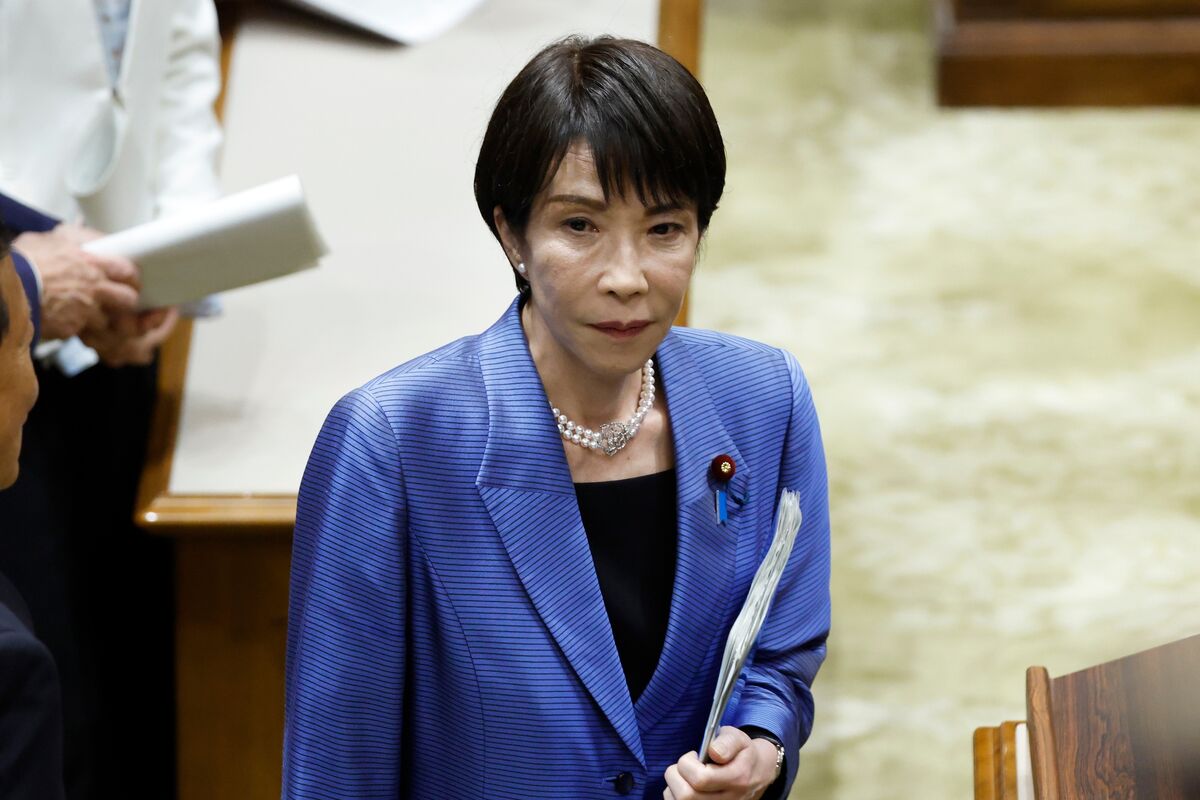
Japanese Prime Minister Sanae Takaichi told parliament that Tokyo 'understands and respects' Beijing's view that Taiwan is an 'inalienable part of its territory,' while stopping short of explicitly endorsing the One China principle, and said Japan's position remains unchanged from the 1972 Japan‑China joint communique. The reaffirmation preserves diplomatic continuity and should limit immediate market disruption, though it maintains geopolitical ambiguity that investors should monitor for implications to regional risk and Japan–China relations.
Market structure: Takaichi’s restatement is continuity rather than escalation — that marginally lowers a Japan-Taiwan geopolitical risk premium. Near-term beneficiaries are China equities and exporters (slight positive flow into FXI/ASHR), while defense primes (RTX, LMT, NOC) and Japan-focused defense suppliers face modest pressure on forward order-risk. FX and rates: a small decline in safe‑haven JPY demand (USD/JPY +1–2% range over weeks) and a 5–15bp compression in global risk premia (VIX down small) are likely if no follow-on events occur.
Risk assessment: Tail risk remains low-probability/high-impact — estimate 5–12% chance of military escalation within 12 months with 30–50% downside shock to regional equities and a sharp JPY rally. Immediate (days) market reaction should be muted; short-term (weeks–months) sees volatility re-pricing around Taiwan elections, US arms sales, and Chinese military drills; long-term (12–36 months) depends on US-China tech decoupling and Japan’s defense policy choices. Hidden dependency: Taiwan semiconductor chokepoints (TSM, ASML exposure) mean even diplomatic calm doesn’t remove systemic supply risk.
Trade implications: Favor measured pro‑China risk taking and tactical cuts to defense exposure. Specific tactical ideas: 2–3% long in FXI/ASHR or 1–2% long TSM (ticker TSM) over 3–6 months; trim defense primes by 1–2% each (RTX, LMT, NOC) and fund with semiconductor/equipment longs (ASML). Options: buy 3‑month put spreads on top defense names sized 0.5–1% portfolio as cheap tail hedges; enter a small USD/JPY long (50–100bp) targeting +1.5% with a 2% stop.
Contrarian angles: The market may underprice the chance that this reiteration fosters complacency — under-hedged portfolios could face outsized losses if a shock occurs. Historical parallel: 1972 normalization did not prevent later crises (e.g., 1996 Taiwan Strait), so don’t fully exit defense exposure; instead rotate to a barbell: reduced core defense weight plus explicit low-cost tail hedges. Unintended consequence: if markets interpret continuity as de-risking, cyclical exporters in Japan and China could re-rate faster than expected, so keep rebalancing triggers (e.g., FXI +8% or USD/JPY +3%) to lock gains.
AI-powered research, real-time alerts, and portfolio analytics for institutional investors.
Request DemoOverall Sentiment
neutral
Sentiment Score
0.00
