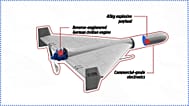
Former CIA Director David Petraeus said European countries could join US-Israel operations against Iran, predominantly in air and missile defence roles, while US ground forces are ruled out; he noted Iranian retaliation has extended beyond Israel to regional civilian infrastructure, airfields, ports and even UK bases in Cyprus. Petraeus warned of continued casualty risk and suggested a possible (but uncertain) internal political shift in Iran after the reported killing of Ayatollah Ali Khamenei, a development with significant implications for regional stability and potential upside pressure on defence and energy markets.
Market structure: Immediate winners are defense primes (Lockheed Martin LMT, Raytheon RTX, Northrop NOC, General Dynamics GD) and missile/air-defence equipment suppliers as demand for interceptors, radars and sustainment rises; oil/energy producers (XLE, OXY) gain if Strait disruptions or >$10/bbl shock occurs. Losers are EM equities (EEM), regional airlines/shipping (ZIM not listed), and tourism-exposed European travel names if conflict widens. Pricing power shifts toward prime contractors and specialty component suppliers where lead times and export-controls create 6–18 month revenue visibility improvements; consumer cyclicals face demand hit if risk-premia persist.
Risk assessment: Tail risks include a major oil shock (>+$30/bbl Brent) or escalation to wider Gulf closure (low-probability, high-impact) and asymmetric cyber/insurance losses hitting carriers/reinsurers (AIG, ACE/Berkshire exposure). Near-term (days–weeks) expect VIX spikes and USD strength; medium (3–6 months) sees defense order announcements and budget reprogramming; long-term (12–36 months) depends on sustained European involvement and Iran regime outcome. Hidden dependencies: supply-chain bottlenecks (specialized semiconductors, titanium) and export licensing could limit suppliers’ ability to scale quickly.
Trade implications: Favor selective longs in large defense primes (LMT/RTX/NOC) via bull-call spreads to limit drawdown, and long oil call or energy E&P exposure if Brent breaches $90 with >$15 move. Hedge EM downside with put spreads on EEM and buy 3-month VIX call spreads as insurance (target 30% cost of portfolio tail hedge). Rotate 3–6% from discretionary cyclicals into defense/energy; expect alpha realization in 6–12 months.
Contrarian angles: Consensus underestimates duration of elevated defence budgets and overprices EM contagion as permanent; defense multiples often expand 10–20% post procurement cycles but can mean-revert if conflict shortens. Gold and Treasuries may be overbought on first shock — wait for a secondary leg higher (VIX >35 or Brent >$95) before adding large safe-haven positions. Small-cap or niche suppliers with order backlogs offer higher asymmetric upside vs. crowded mega-cap defense names.
AI-powered research, real-time alerts, and portfolio analytics for institutional investors.
Request TrialOverall Sentiment
moderately negative
Sentiment Score
-0.55
