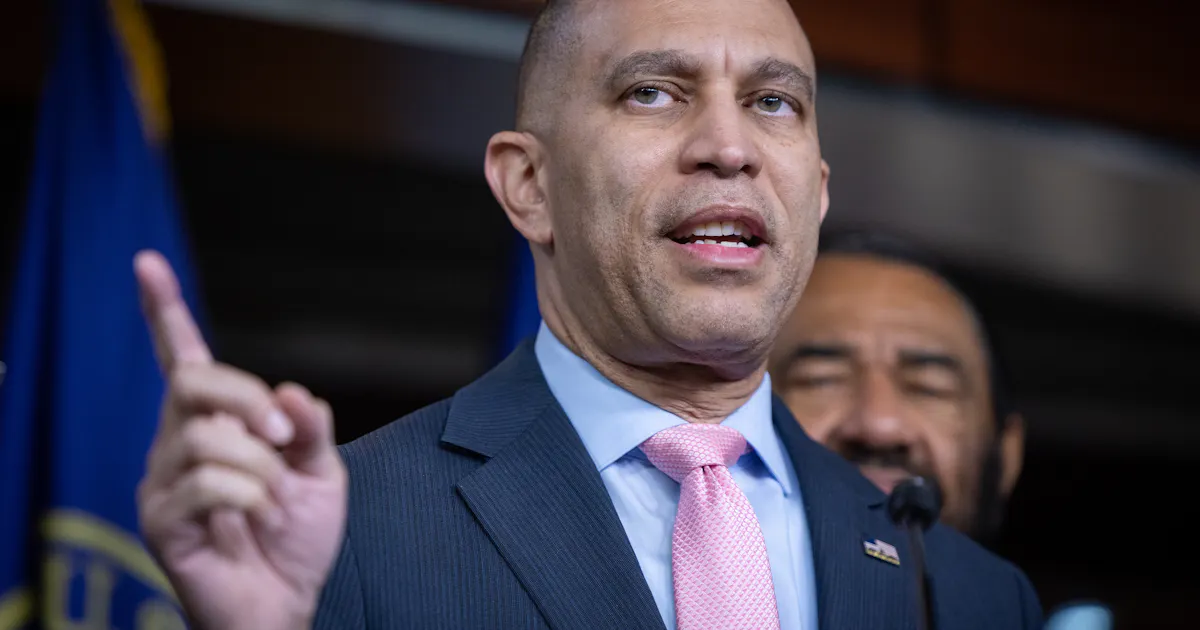
House Minority Leader Hakeem Jeffries has directed Rep. Joe Morelle to lead New York redistricting efforts after the Supreme Court's 6–3 Louisiana v. Callais ruling weakened Section 2 Voting Rights Act protections and made partisan gerrymandering easier to defend. The move follows signals from New York Gov. Kathy Hochul and mirrors Florida's newly drawn map aimed at adding four Republican seats for the 2026 midterms. The article points to a broader national redistricting fight that could reshape House control, but it is political rather than directly market-specific.
The market implication is not the redistricting headlines themselves, but the rising probability of a narrower, more volatile House map that increases the value of incumbency, fundraising capacity, and candidate quality. That tends to favor sectors with high policy beta and long-duration regulatory exposure because a slimmer majority makes legislative outcomes more binary: more stop-go fiscal policy, more debt-ceiling theater, and a higher chance of concession-driven spending packages rather than clean policymaking. Second-order, the biggest beneficiaries are not partisan-aligned assets per se, but firms that monetize gridlock or earn from procedural churn: election infrastructure, political media, and defense/lobby-heavy incumbents that can price in more status quo persistence if Congress becomes more fragmented. The losers are policy-sensitive names that need clean legislative follow-through—healthcare reimbursement reform, clean-energy subsidies, and any business model leaning on stable federal appropriations over the next 12–18 months. The key risk is that markets are likely underestimating how quickly district manipulation can change the seat count from noise into control odds. If a handful of seats shift in either direction, the 2026 midterm pricing regime changes well before Election Day; expect the most violent repricing in polling-sensitive sectors to begin 3–6 months before primary season, when donor flows and candidate recruitment data start to matter more than national polls. Contrarian view: the consensus may be overstating the permanence of a redistricting wave. Court, state, and procedural constraints can delay implementation, and the bigger market effect may come from legal uncertainty rather than the eventual map. That argues for trading volatility around catalyst windows rather than making a one-way political macro bet.
AI-powered research, real-time alerts, and portfolio analytics for institutional investors.
Request DemoOverall Sentiment
mildly negative
Sentiment Score
-0.15
