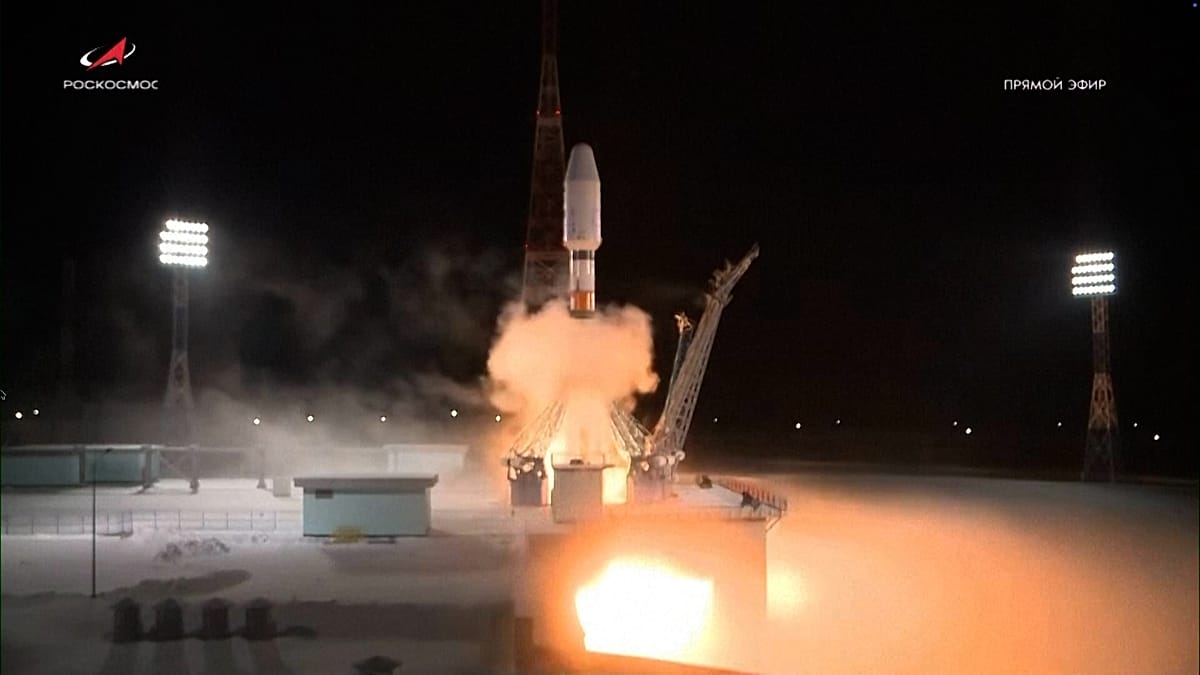
Russia launched three Iranian communications satellites (Paya — 150 kg, Kowsar — 35 kg, and Zafar-2 — weight not specified) into a 500 km orbit from the Vostochny pad, marking a second such launch since July and underscoring growing Russia–Iran strategic ties. The satellites provide up to 3‑meter resolution imagery with lives up to five years, enhancing Iran's remote‑sensing and communications capabilities; the launches have drawn U.S. criticism as potentially violating past U.N. resolutions and raise geopolitical and sanction‑risk considerations for regional assets and defense/space supply chains.
Market-structure: Short-term winners are defense primes (Lockheed Martin LMT, Raytheon RTX, General Dynamics GD) and satellite-imagery/data firms (Maxar MAXR, Planet Labs PL) that sell services to governments; losers include insurers/reinsurers exposed to regional conflict and non-Western launch-service providers reliant on Russian ties. The tactical effect is modest market-share shifting in small-satellite launch demand: Russia filling Iran’s needs reduces addressable launches for Western small-launch providers by a few percent but increases long-term demand for resilient, export-compliant launch capacity.
Risk assessment: Tail risks include kinetic escalation (Israel/Iran/US) that lifts Brent >$95/bbl within days and spikes defense-equity volatility +30% intraday, or US/EU re-imposition of export controls banning component sales to Russia/Iran, disrupting supply chains for smallsat manufacturers over 3–12 months. Immediate window (days): commodity and FX moves; short-term (weeks–months): defense re-rating and EM spread widening; long-term (1–3 years): structural bifurcation of space supply chains and export-control-driven reshoring.
Trade implications: Favor 1–2% tactical allocations to ITA or equal-weight XAR and direct 1% positions in LMT and RTX for 3–9 months; add 0.5–1% exposure to MAXR or PL on any pullback >10% (buy-the-dip threshold). Hedging: buy a 3–6 month Brent call spread (BNO or Brent futures) with strike pair roughly $90/$110 if Brent >$85, and buy short-dated 30–60 day put protection on core long equities if VIX jumps >5 pts.
Contrarian angle: Consensus will overweight pure defense longs; underappreciated is that commoditization of imagery (PL/MAXR) pressures margins — prefer vertically integrated payload manufacturers and resilient launchers like Rocket Lab (RKLB) on >20% pullbacks, but watch export-control news (30–90 day catalyst) which could flip winners into losers.
AI-powered research, real-time alerts, and portfolio analytics for institutional investors.
Request DemoOverall Sentiment
neutral
Sentiment Score
-0.10
