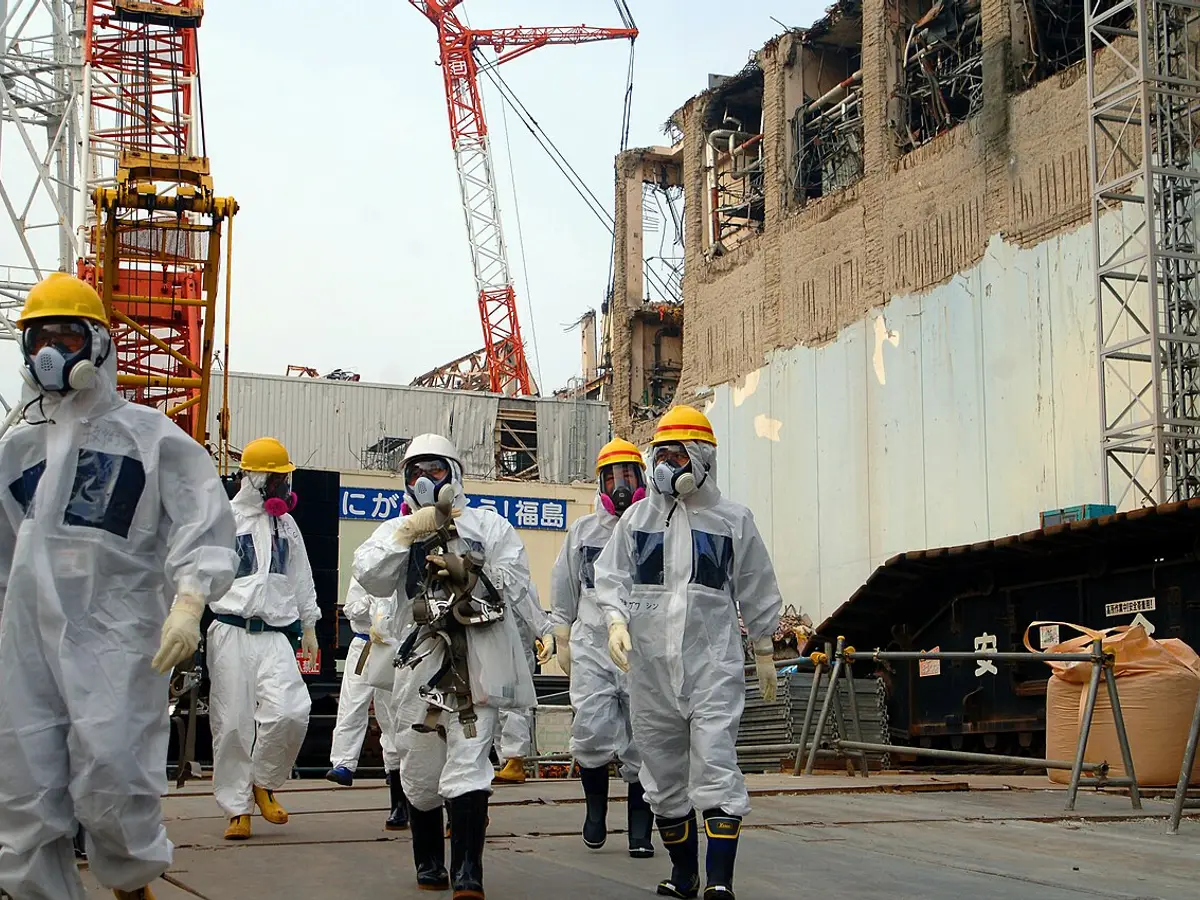
A magnitude-9 earthquake on March 11, 2011 triggered a ~15-metre tsunami that knocked out power and cooling at Fukushima Daiichi, causing meltdowns in three reactor cores within 72 hours and classifying the incident as a level-7 nuclear disaster after roughly 940 petabecquerels of radioactive release between days four and six. All four reactors (combined net capacity 2,719 MWe) were deemed beyond repair; within two weeks reactors 1–3 were stabilised by continuous water injection, cooling was maintained with treated recycled water by July and a formal cold shutdown was declared in mid-December, while contaminated water leaks remained a major remediation issue. The disaster prompted the evacuation of over 100,000 people, long-term government restrictions preventing many returns, and 2,313 officially recorded disaster-related evacuee deaths in Fukushima prefecture in addition to ~19,500 deaths from the quake and tsunami — outcomes with enduring implications for Japan’s energy policy, regulatory environment and long-run costs of cleanup and decommissioning.
Market structure: Persistent nuclear aversion after events like Fukushima reallocates demand toward natural gas, renewables and remediation services. Winners: LNG exporters and large renewables developers (improved pricing power in Asia; potential 5–20% premium in winter spot LNG in stressed years). Losers: legacy nuclear operators/utilities with decommissioning liabilities and uranium producers facing demand uncertainty (downside risk 10–30% in spot-sensitive miners).
Risk assessment: Tail risks include major regulatory reversals (e.g., massive government underwriting of decommissioning costs), a new high-profile nuclear incident, or a geopolitical energy shock that re-rates gas prices >30% in months. Time horizons: price effects manifest immediately for LNG and power spreads, over 3–12 months for developer capex reallocation, and 12–60 months for decommissioning contract flows. Hidden dependencies: government fiscal capacity to fund cleanup, JPY/JGB moves that influence Japanese utility credit spreads, and supply-chain constraints for renewables (copper, polysilicon).
Trade implications: Favor long exposures to large, diversified LNG majors and established renewable utilities while shorting spot-exposed uranium/miners; size trades for 1–3% of portfolio each and horizon 6–24 months. Use defined-risk option structures (9–12 month call spreads) to express convexity in LNG/renewable names and buy protective puts on utilities with decommissioning exposure. Entry window: act within 30–90 days; trim into 6–12 month rallies or on regulatory clarity.
Contrarian angles: Consensus may overstate permanent nuclear decline—France/China policy could re-accelerate nuclear, creating a 12–36 month reversal risk; Fukushima-like shocks historically produce multi-year but not permanent demand destruction. Unintended consequence: short-term coal rebound raises carbon/regulatory risk for fossil long positions; seek relative-value pairs to hedge this pathway.
AI-powered research, real-time alerts, and portfolio analytics for institutional investors.
Request DemoOverall Sentiment
strongly negative
Sentiment Score
-0.70
