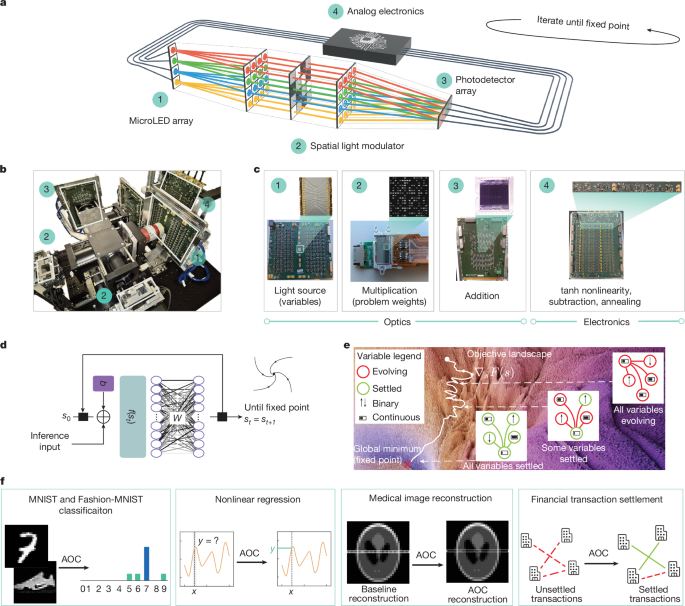
Researchers have developed an Analog Optical Computer (AOC) that significantly advances sustainable computing by offering over 100-times greater energy efficiency than leading GPUs for both AI inference and combinatorial optimization workloads. This single platform, leveraging analog electronics and 3D optics, utilizes a rapid fixed-point search to accelerate compute-intensive tasks such as image classification, medical image reconstruction, and financial transaction settlement, demonstrating superior performance and noise robustness compared to traditional digital and even some quantum solutions. The AOC's ability to handle complex problems like financial transaction settlement with 100% success rates and outperform commercial solvers by orders of magnitude positions it as a potentially transformative technology for institutions requiring highly efficient and powerful computational capabilities.
Researchers have introduced a novel Analog Optical Computer (AOC) that demonstrates a significant leap in computational efficiency for both AI inference and complex combinatorial optimization. The platform's core innovation is its ability to perform these dual workloads on a single, fully analog architecture, which eliminates energy-intensive digital-to-analog conversions. The research projects a potential energy efficiency of 500 tera-operations per second (TOPS) per watt, a more than 100-fold improvement over leading graphics processing units (GPUs) from companies like Nvidia, which achieve approximately 4.5 TOPS/W. This breakthrough directly addresses the escalating energy demands of AI, a key ESG and cost concern for datacenter operators. In practical demonstrations, the AOC achieved a 100% success rate on financial transaction settlement problems, outperforming published results from quantum hardware (40-60% success), and was orders of magnitude faster than commercial solvers like Gurobi on certain industry benchmarks. This development, led by researchers with ties to Microsoft (MSFT), leverages scalable, consumer-grade components from suppliers such as Analog Devices and Texas Instruments, suggesting a viable, albeit long-term, roadmap to commercialization and a potential disruption to the current GPU-dominated AI hardware landscape.
AI-powered research, real-time alerts, and portfolio analytics for institutional investors.
Request DemoOverall Sentiment
extremely positive
Sentiment Score
0.80
Ticker Sentiment
