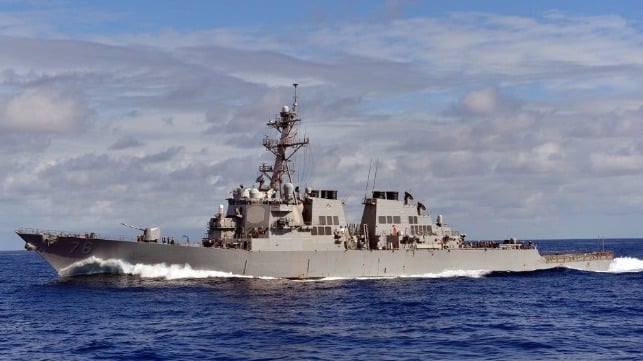
A U.S. Navy Arleigh Burke-class destroyer, USS Higgins, suffered a serious fire in the Indo-Pacific that reportedly knocked out propulsion and electrical power. No injuries were reported, but the incident adds to a third U.S. Navy warship fire event this year and raises operational-readiness concerns for forward-deployed assets in a sensitive region.
This is less a one-off maintenance headline than a readiness signal for the U.S. forward-deployed fleet. If propulsion and electrical systems are truly compromised on a Burkes-class hull that is designed for redundancy, the market should infer either unusually severe damage or a latent maintenance/training problem that can propagate across the same class of assets. The second-order effect is not just one destroyer offline; it is a tighter near-term supply of credible Aegis presence in the Western Pacific, which forces the Navy to stretch remaining hulls and increases operational tempo on the rest of 7th Fleet. The immediate beneficiaries are not defense primes in a revenue sense, but the policy logic shifts toward higher sustainment and recapitalization urgency. That tends to favor names with exposure to ship repair, combat systems upgrades, and naval maintenance over pure new-build exposure, because fleet availability problems usually trigger quicker funding for depot work than for long-cycle platform procurement. The loser is any expectation that the U.S. can maintain persistent deterrence posture in multiple flashpoints without incurring higher maintenance burn and spare-parts consumption. The key risk is that this compounds with the recent pattern of shipboard fires and turns into a congressional narrative around readiness, which could accelerate near-term budget reallocations toward maintenance, safety systems, and crew training over discretionary modernization. Over days to weeks, the headline is mainly sentiment-negative for defense logistics and shipyards; over months, it is positive for the repair/aftermarket ecosystem if the Navy is forced to pay up for availability. A contrarian view is that the market may over-rotate on “fleet weakness” while ignoring that such incidents historically produce incremental funding rather than reduced defense spending. The biggest hidden variable is operational capacity in the Indo-Pacific over the next 3-6 months: one less destroyer matters more when deployment cycles are already tight and allied burden-sharing is still incomplete. If this becomes a class-wide inspection or grounding issue, the impact could spread to schedule delays, higher depot demand, and temporary strain on missile-defense coverage. If the Navy quickly restores the ship and shows no broader systemic issue, the trade should mean-revert fast.
AI-powered research, real-time alerts, and portfolio analytics for institutional investors.
Request DemoOverall Sentiment
moderately negative
Sentiment Score
-0.45
