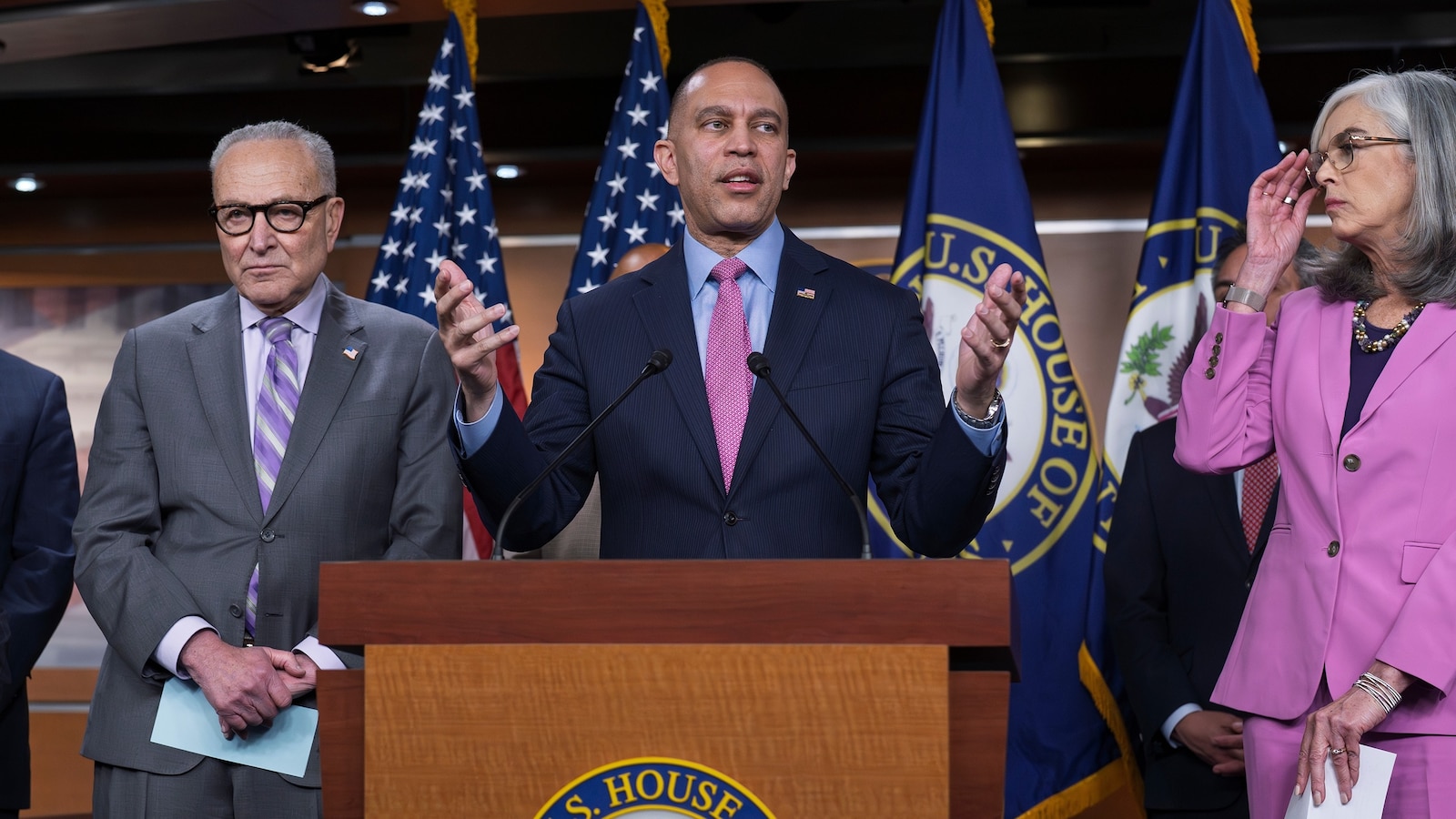
Democratic leaders, unified after recent deadly federal law enforcement shootings, are demanding substantive DHS policy changes — including judicial warrants for ICE actions, an end to roving patrols, a ban on agents wearing face masks and mandatory body cameras — and are prepared to withhold votes on a DHS continuing resolution ahead of a Feb. 13 deadline. Republicans, led by Speaker Mike Johnson, reject some proposals (notably the mask ban) and warn a lapse would disrupt TSA, FEMA, the Coast Guard and Secret Service, creating short-term operational risks to travel and disaster response and a domestic political standoff that could modestly roil markets if a shutdown occurs.
Market Structure: The February 13 DHS funding cliff concentrates short-term risk on travel/transport (TSA—airlines: AAL, DAL, UAL, LUV; ETF JETS) and on immigration/detention contractors (GEO, CXW). A short, partial DHS lapse would cause operational hiccups (TSA screening delays, FEMA pause) that can shave 1–3% off airline quarterly revenue per week of disruption and create immediate negative sentiment for detention names that rely on ICE policy. Defense primes with broader DoD/CISA revenue (LDOS, RTX) are less exposed and may pick up reallocated work.
Risk Assessment: Tail risks include a multi-week DHS shutdown (>10 trading days) or passage of restrictive ICE rules that cut detained populations 5–15% over 12 months — both would materially pressure GEO/CXW and leisure travel demand. Immediate horizon (days): headlines and Feb 13 deadline drive volatility; short-term (weeks): legislative text and White House posture; long-term (quarters): enacted policy or funding patterns that permanently change contractor revenue. Hidden dependency: many DHS functions are interlinked—TSA disruptions flow into airport retail, MRO, and short-term oil demand.
Trade Implications: Tactical plays favor defined-risk shorts/puts on GEO and CXW (size 2–4% net portfolio) and buying short-dated JETS put spreads to capture travel-disruption skew into mid-March. Pair trade: long LDOS (1–2%) vs short CXW (1–2%) to express security-services resilience vs detention exposure. Interest-rate/FX hedge: allocate 2–3% to long-duration Treasuries (TLT) or short-term bill ETF (SHY) if shutdown probability >30% by Feb 10, as safe-haven demand will compress yields.
Contrarian Angles: The market may over-penalize large defense primes and broad travel equities for a likely short-lived standoff; historically <7-day DHS lapses produce transient price moves and mean-revert. What’s missed is that ICE operational funding has other backstops (earmarked appropriations passed earlier), so downside for GEO/CXW is conditional on durable legislative change—trade with tight stop-losses and size accordingly. Catalysts to watch: published bill text, White House sign-off, and a >5-point swing in public opinion polls within 7 days.
AI-powered research, real-time alerts, and portfolio analytics for institutional investors.
Request DemoOverall Sentiment
moderately negative
Sentiment Score
-0.45
