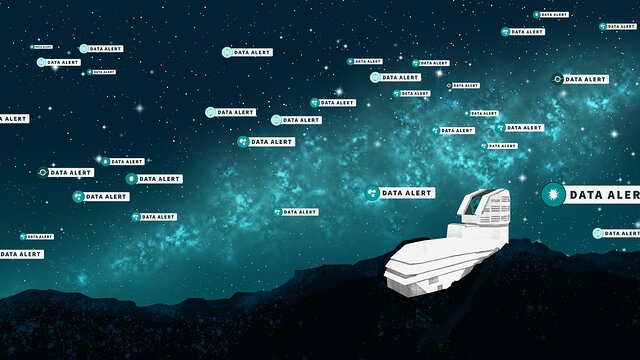
The NSF–DOE Vera C. Rubin Observatory has begun issuing real-time public alerts of transient astronomical events, releasing roughly 800,000 alerts on 24 February and ramping toward an expected capacity of up to 7 million alerts per night. Equipped with a 3,200‑megapixel LSST Camera that images a new sky region every 40 seconds and publishes change-detection alerts within two minutes, the system will feed broker networks and machine‑learning pipelines, creating a sustained, massive data stream with clear implications for compute, data‑infrastructure and downstream science platforms.
Market structure: Rubin’s public, near-real-time stream (already 10 TB/night; up to 7M alerts/night) shifts value to cloud compute, GPU providers, data-center operators, and ML broker platforms that filter/monetize alerts — expect incremental infrastructure demand of ~5–15% for specialized GPU/CPU instances and 3–6 PB of archival capacity annually as LSST ramps. Downstream winners: GOOGL (Pitt‑Google broker exposure + Cloud ML stack), NVDA (GPUs), EQIX/DELL/AMZN (data-centers/cloud); losers are small observatories and proprietary data vendors lacking scale or real‑time pipelines.
Risk assessment: Tail risks include a sustained SLAC/data‑center outage, export controls on high-end GPUs, or NSF/DOE budget cuts — any of which could compress expected revenue flow to cloud vendors; probability low but P&L impact high. Immediate market impact is muted (days); expect measurable procurement/RFP activity and revenue recognition shifts over 3–12 months; durable recurring demand for cloud/ML services over 1–5 years.
Trade implications: Direct plays — establish modest, risk‑managed exposure to cloud/AI infrastructure: GOOGL (capture broker/cloud uplift) and NVDA (GPU compute). Use options to cap downside and sell calls to fund longs; overweight data‑center REITs (EQIX) to capture colocation demand. Rotate out of small-cap instrumentation names with low recurring revenue and high capex.
Contrarian angles: Consensus underestimates the deflationary effect of public alerts on premium proprietary datasets (reduces pricing power for niche data vendors) while overestimating near‑term revenue for hardware vendors — infrastructure/software capture most value. Watch for ESG/local permitting pushback and rising power costs (could raise colocation margins by 100–200 bps), which are often ignored in bull narratives.
AI-powered research, real-time alerts, and portfolio analytics for institutional investors.
Request DemoOverall Sentiment
mildly positive
Sentiment Score
0.30
Ticker Sentiment
