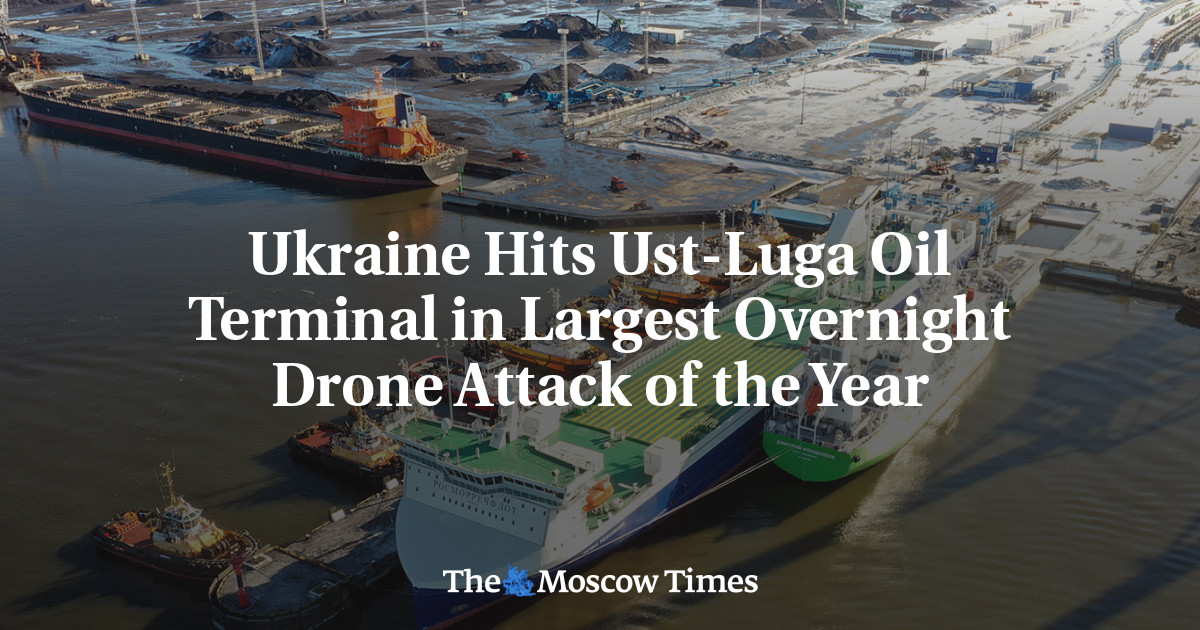
Ukraine launched its largest overnight drone wave of the year, with Russia reporting 389 drones downed overall and 56 intercepted over the Leningrad region; the attacks sparked fires at the Ust-Luga port, a terminal capable of handling ~700,000 barrels/day, and damaged other ports and local infrastructure. The strikes have forced temporary halts at key export hubs, caused major regional power outages (~450,000 people in Belgorod) and elevated the risk of oil supply disruption, increasing volatility in global energy markets amid concurrent Middle East tensions.
The immediate market transmission is through seaborne logistics and insurance: damage or shutdowns at a handful of northern export nodes will reallocate flows to longer sailings and alternative hubs, tightening tanker availability and pushing spot freight and time-charter rates sharply higher in the coming days. Expect a near-term crude premium shock (days–3 weeks) as arbitrage desks rebuild cargo routes and physical barrels take 7–21 days extra transit time; this is a highly convex, supply-chain-driven price shock rather than a fundamental loss of barrels.
Second-order effects concentrate on cost-of-delivery and refinery intake mismatch in Northwest Europe. Higher war-risk premiums and longer voyage days will widen crude-to-product cracks for refiners reliant on short-haul Baltic shipments while advantaging refiners and traders with access to Mediterranean or Black Sea supply (and those who can swing to heavier grades). Cargo insurers and reinsurers will see pricing power; P&I clubs and specialty war-risk underwriters can reprice within a month and materially lift H1 revenues.
Tail risks skew asymmetric: escalation that closes multiple chokepoints or prompts reciprocal interdiction of commercial shipping would push structural dislocation into months and justify much higher risk premia; conversely, rapid diplomatic de-escalation or forced rerouting with discounted Russian cargo sales to Asia can shave the premium within 4–12 weeks. Volatility favors short-dated, directional optionality for immediate exposure and equity plays for 3–12 month convexity to structural premium repricing.
For portfolio construction, prefer liquid, high-convexity instruments (short-dated Brent calls or BNO call spreads) and equities that directly capture freight and insurance repricing rather than broad commodity ETF exposure. Size these trades so that a 10% realized move in Brent or a 50–150% move in tanker dayrates maps to 2–6% portfolio impact, with explicit downside stops linked to route re-openings or announced diplomatic corridors.
AI-powered research, real-time alerts, and portfolio analytics for institutional investors.
Request DemoOverall Sentiment
strongly negative
Sentiment Score
-0.70
