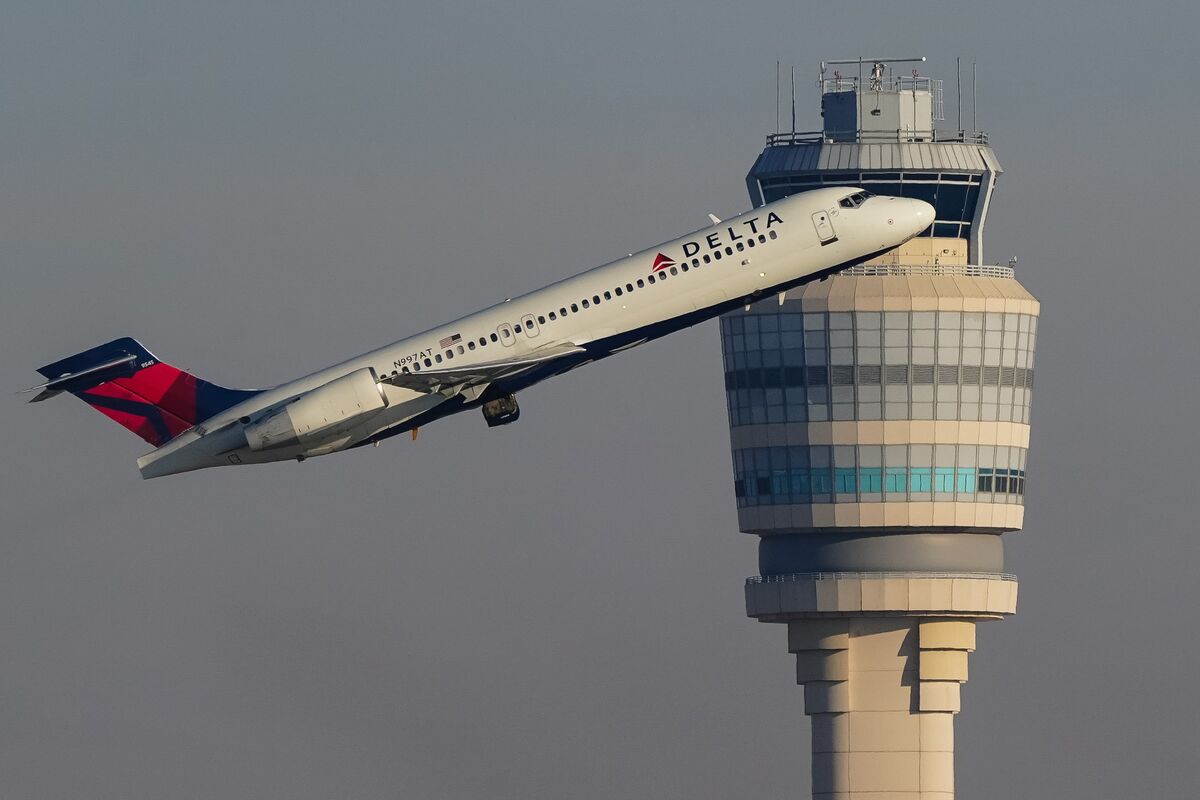
Delta Air Lines said it expects a roughly $200 million profit hit in Q4 (quarter ending Dec. 31) after cutting flights amid the recent record government shutdown, according to a stock-exchange filing ahead of an investor conference. Management added that demand remains healthy through the quarter and into early 2026 and that booking growth has rebounded to initial expectations following the shutdown disruption.
Market structure: The $200M Q4 hit is a near-term demand shock concentrated at DAL and other network carriers forced to cut capacity; low-cost carriers with flexible schedules (LUV, JBLU) and online travel agencies (EXPE, BKNG) can capture displaced travelers in the short run. Pricing power is likely intact as management says bookings returned, so fare rates should re-normalize within 6–12 weeks unless corporate travel weakens materially. Cross-asset impact: expect modest spread widening for DAL credit (+10–30bps risk premium potential) and a short-lived rise in equity implied volatility; jet fuel sensitivity remains a dominant macro lever for 3–12 month performance.
Risk assessment: Tail risks include a prolonged or recurring shutdown, major hub disruptions, or a simultaneous oil spike (> +20% in 30 days) that would convert a $200M hit into a multi-quarter cash flow problem. Immediate (days) risk is volatility around the filing and investor day, short-term (weeks) is Q4 bookings cadence and fare realization, long-term (quarters) depends on corporate travel recovery into 2026. Hidden dependencies: hub-specific revenue per available seat mile (RASM) and international exposure can magnify effects; catalysts to monitor are weekly bookings, TSA throughput, and crude >$90/bbl.
Trade implications: If DAL trades down 5–10% on headlines, initiate a 2–3% long position (ticker DAL) targeting a 15–25% mean reversion within 2–3 months, stop-loss at 10%. Relative trade: long AAL 2% / short DAL 2% if DAL guidance weakens but domestic leisure demand holds (AAL higher leisure mix). Options: buy a 90-day DAL call spread (10/20% OTM) financed by selling near-term calls or buy 90-day puts if crude breaches $90 as hedge.
Contrarian angles: The market is likely over-pricing permanence from a one-off political event; historical parallels (2013 shutdown, weather shocks) show full itineraries recover within 4–8 weeks and stocks rebound. Risk of being early is real—if corporate travel confidence slides into 2H26, downside extends, so cap exposures and hedge with short-dated puts. Unintended consequence: competitors could coordinate capacity restores, compressing yields and pressuring margins for 1–2 quarters despite healthy booking backfill.
AI-powered research, real-time alerts, and portfolio analytics for institutional investors.
Request DemoOverall Sentiment
mildly negative
Sentiment Score
-0.25
Ticker Sentiment
