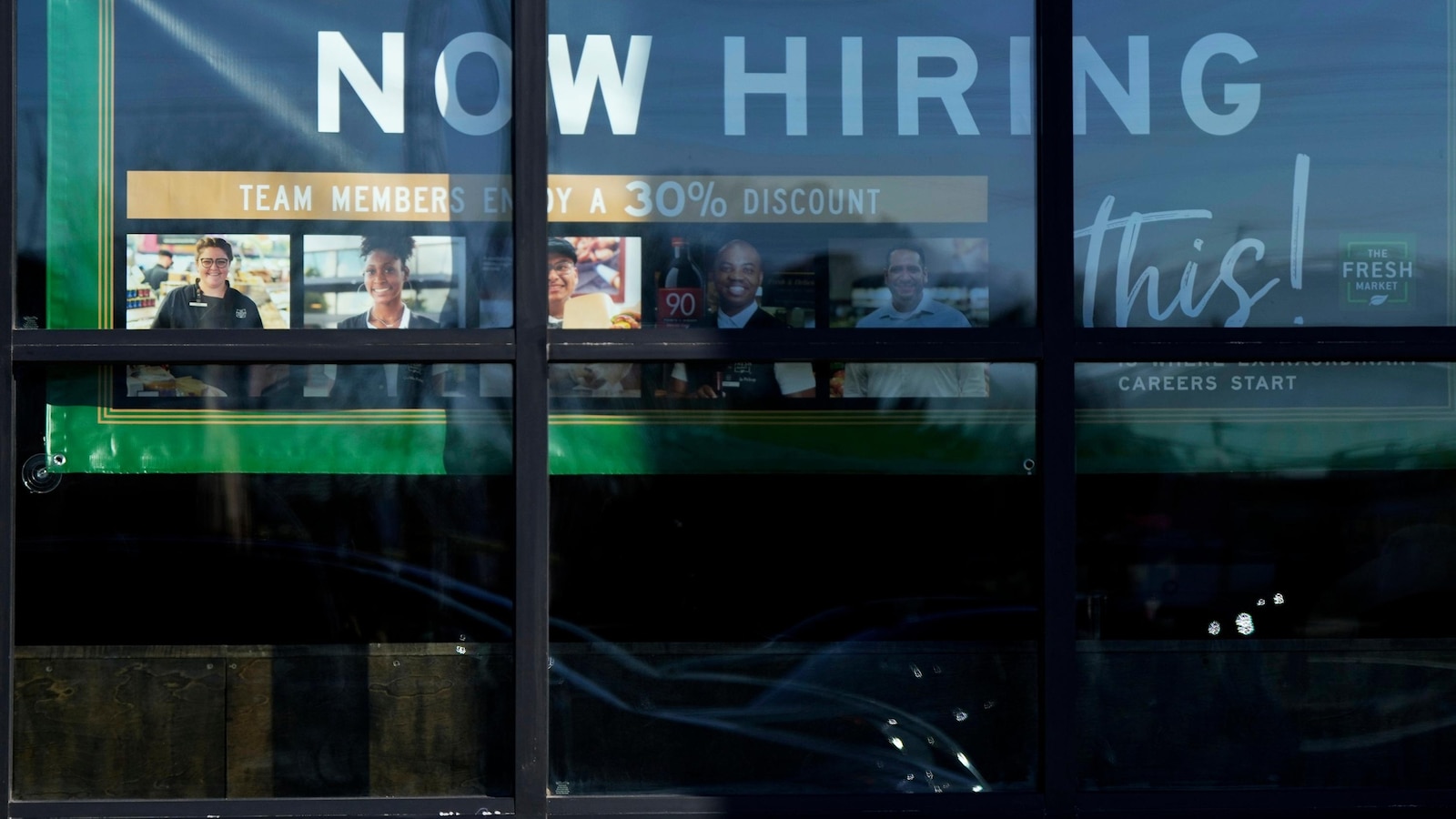
Initial US jobless claims for the week ending Jan. 31 rose 22,000 to 231,000, well above the FactSet consensus of 211,000, while the four‑week moving average climbed to 212,250. Continuing claims for the prior week increased by 25,000 to 1.84 million, reinforcing a softer labor market backdrop that included just 50,000 payroll additions in December and a 4.4% unemployment rate. The report adds to evidence of slowing hiring after 2024's strong gains and comes amid Fed rate moves—three quarter-point cuts late last year and a recent pause—plus policy uncertainty from tariffs, factors that could modestly influence rates and risk sentiment. Investors should monitor further labor and hiring indicators for implications on Fed policy and cyclical exposure.
Market structure: Rising weekly claims to 231k (four-week avg 212k) signals a cooling labor market that directly favors defensives (XLP, XLU), long-duration bonds (TLT) and cash-rich tech names that can buy market share. Hurt are high‑cost labor/reliant operators — logistics (UPS), discretionary e‑commerce (AMZN) and cyclicals (DOW) — where margins compress if demand softens; expect pricing power to shift ~3–6 months toward branded staples and digital incumbents with low fixed cost. Cross-asset: weaker labor raises odds of Fed easing within 3–6 months, which should compress short-end yields, steepen the curve initially and boost gold and FX carry trades (USD downside vs EUR/JPY).
Risk assessment: Tail risk includes a rapid deterioration to weekly claims >300k sustained for 6+ weeks triggering a 20%+ S&P drawdown and credit stress; opposite tail is re-acceleration in payrolls that forces the Fed to stay restrictive. Near-term (days) moves will be headline-driven around the delayed Jan payrolls; medium-term (1–3 months) is where hiring trend confirms cyclical slowdown; long-term (6–18 months) depends on corporate capex and tariff policy. Hidden dependencies: corporate layoffs concentrated in tech/logistics may temporarily raise unemployment but not consumer spending if savings remain; tariffs/tax policy could reaccelerate layoffs.
Trade implications: Tactical: establish 2–3% long in TLT (3–6 month horizon) and 1–1.5% long GLD if 10y yields drop >25bps; short 1–2% positions in AMZN and UPS equity or buy 3‑month put spreads (AMZN: buy 5%/15% put spread sized 1% notional). Pair trades: long XLP (2%) vs short XLY (2–3%) for 3–6 months as discretionary spending tightens. Use options to hedge: buy S&P 1.5% 3‑month put protection if weekly claims breach 240k for 2 consecutive weeks.
Contrarian angles: Consensus expects steady easing; that’s underweighting the chance of a shallow but prolonged slowdown where high‑margin digital platforms (AMZN advertising, AWS) reprice upward and outperform. Reaction may be overdone on headline layoffs — if Jan payrolls (when released) show stabilization or revisions upwards, cyclical shorts will be vulnerable; historically (2003/2012 slowdowns) defensives outperformed early but tech rebounded within 4–8 months as multiples expanded on easing bets. Unintended consequence: aggressive positioning into long-duration bonds risks loss if inflation reaccelerates or tariffs spike input costs.
AI-powered research, real-time alerts, and portfolio analytics for institutional investors.
Request DemoOverall Sentiment
moderately negative
Sentiment Score
-0.45
Ticker Sentiment
