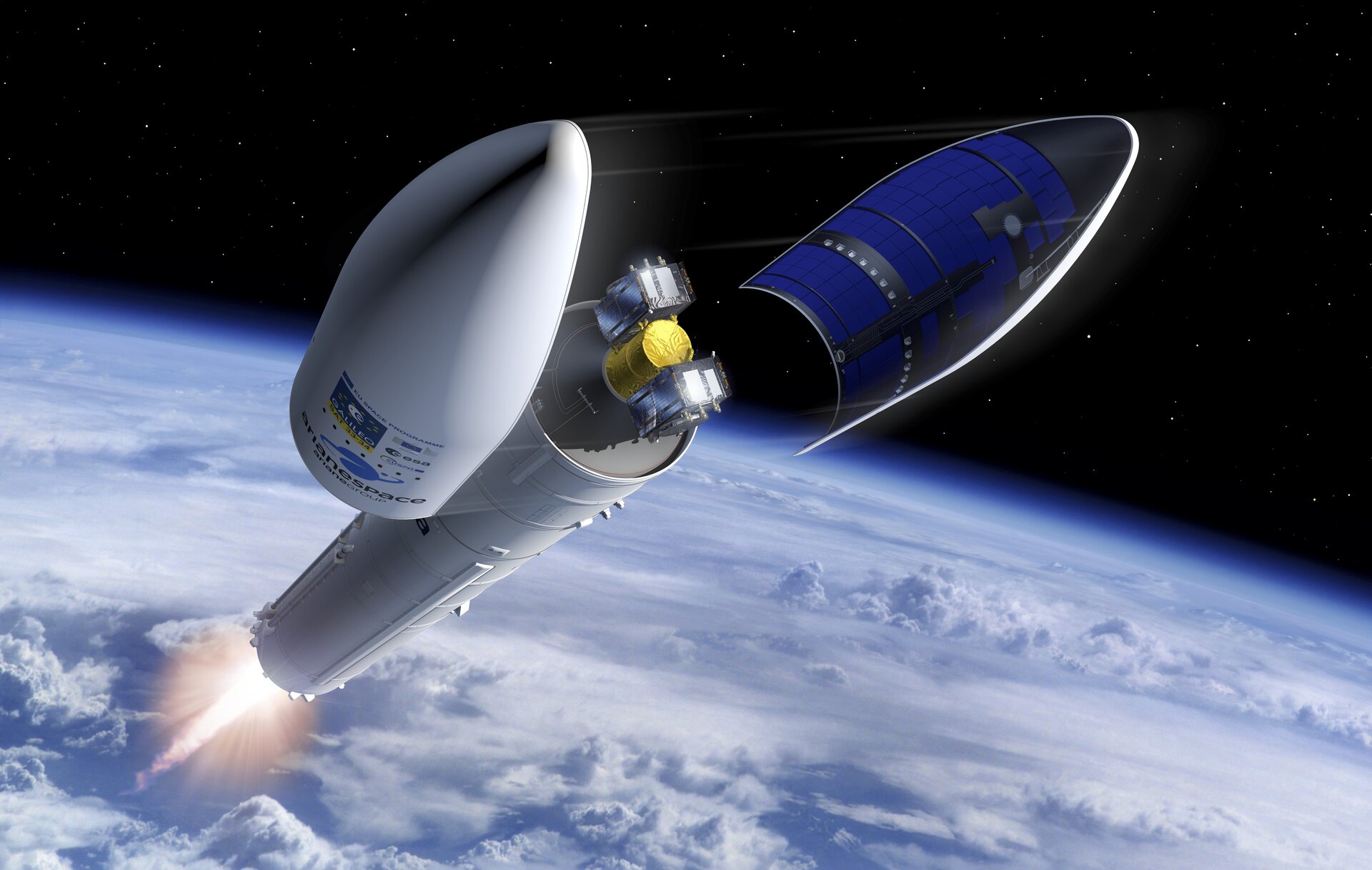
On 17 December two Galileo satellites (SAT 33 and SAT 34) were launched from Europe’s Spaceport in French Guiana aboard Ariane 6 — marking the first Galileo launch on Ariane 6, the launcher’s fifth flight, and the 14th operational Galileo launch overall. The satellites will join the medium Earth orbit constellation at 23,222 km as spares to bolster 24/7 positioning, navigation and timing services; they will undergo a 3–4 month activation and in‑orbit testing phase overseen by EUSPA and ESA before entering service. The flight underscores EU strategic autonomy in space by pairing the Galileo programme with the new Ariane 6 heavy‑lift vehicle and has direct relevance for downstream markets that rely on precise GNSS (smartphones, rail, maritime, agriculture and financial timing services) as well as for the European launch and satellite supply chain.
On 17 December two Galileo satellites, SAT 33 and SAT 34, were launched from Europe’s Spaceport in French Guiana aboard an Ariane 6 rocket; this marked Galileo’s first launch on Ariane 6, the launcher’s fifth flight and the 14th operational launch for the Galileo programme. The satellites are destined for medium Earth orbit at 23,222 km and are designated as spares to bolster 24/7 positioning, navigation and timing services for billions of users.
Post-launch activation and in-orbit testing will be led by EUSPA and ESA over a three-to-four month early operations phase to validate satellite health and performance before entry into service, with a European Commission post-launch event to follow. Galileo is described as the world’s most precise navigation system, serving over five billion smartphone users since 2016 and embedded in all smartphones sold in the European Single Market, with downstream relevance to rail, maritime, agriculture, financial timing and rescue operations.
Ariane 6’s two-booster configuration for this mission (core Vulcain 2.1 engine, P120C boosters and a reignitable Vinci upper stage performing two burns) underscores EU efforts for autonomous access to space; sentiment in the accompanying data is mildly positive (score 0.3) with a modest market impact score (0.25). The principal near-term risk is technical — successful in-orbit testing and continued Ariane 6 flight reliability will determine whether this launch materially strengthens commercial and supply-chain prospects for European launch and satellite vendors.
AI-powered research, real-time alerts, and portfolio analytics for institutional investors.
Request DemoOverall Sentiment
mildly positive
Sentiment Score
0.30
