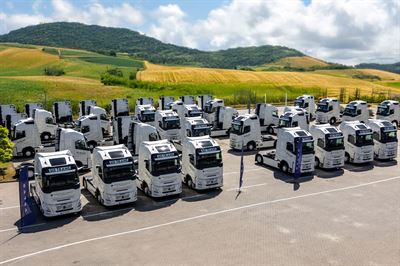
Volvo Trucks has secured two sizable fleet orders from HayWay Group: 80 Volvo VNL 860 sleeper tractors for HayWay’s U.S. market entry and 150 Volvo FH Aero trucks for Poland (via SIS Trans). HayWay — a 19-company group — will operate the U.S. VNL fleet on long‑haul routes between Southern California and New York and plans to scale to a 1,400-vehicle fleet by 2029 in cooperation with Volvo Trucks and Volvo Financial Services. While modest relative to Volvo’s ~134,000 global deliveries in 2024, the orders signal a strategic partnership, aftermarket/dealer service revenue (TEC Equipment on the West Coast) and potential financing opportunities tied to HayWay’s planned rapid expansion.
Market structure: The direct winners are Volvo Group (VOLV-B) and its financing arm (Volvo Financial Services) plus Volvo’s West Coast dealers (TEC Equipment) — they capture truck sales, service R&M and captive-finance income. The scale is modest short-term (80 trucks now, plan 1,400 by 2029 ≈ ~250 vehicles/year incremental), representing <<1% of US Class‑8 annual sales (≈250–300k), but the strategic win vs. US incumbents signals brand preference and a potential gradual share shift over 3–5 years.
Risk assessment: Tail risks include dealer/service bottlenecks (if uptime <95% for new fleet, reputational damage), regulatory/emissions shifts (new EPA rules or state-level zero‑emission mandates) and HayWay financial stress from high CapEx. Immediate impact is noise (days); meaningful credit/earnings effects will play out over quarters (3–12 months) and strategic market-share/finance benefits over years (2025–2029). Key hidden dependency: Volvo Financial Services underwriting and residual values — a 10% drop in residuals would meaningfully compress FFS ROE.
Trade implications: Favor a modest directional play on Volvo exposure and relative-value vs US incumbents. Buy VOLV-B exposure to capture OEM + finance upside; implement cost‑controlled options (see decisions). Short/underweight Paccar (PCAR) or Daimler Truck relative to VOLV-B as a pair if share gains accelerate. Rotate into European truck suppliers/aftermarket names and away from small US-centric fleets if diesel prices rise >10% in 3 months.
Contrarian angles: The market may underweight service/finance annuity value versus headline unit sales — the real upside is recurring FFS income and dealer R&M, not only truck shipments. Conversely, the impact can be overhyped: historical EU OEM US entries took multiple years to move share; if HayWay fails to scale beyond ~300 trucks by 2026 or if diesel spikes >15% y/y, downside to the trade is asymmetric, so size positions conservatively.
AI-powered research, real-time alerts, and portfolio analytics for institutional investors.
Request DemoOverall Sentiment
moderately positive
Sentiment Score
0.45
