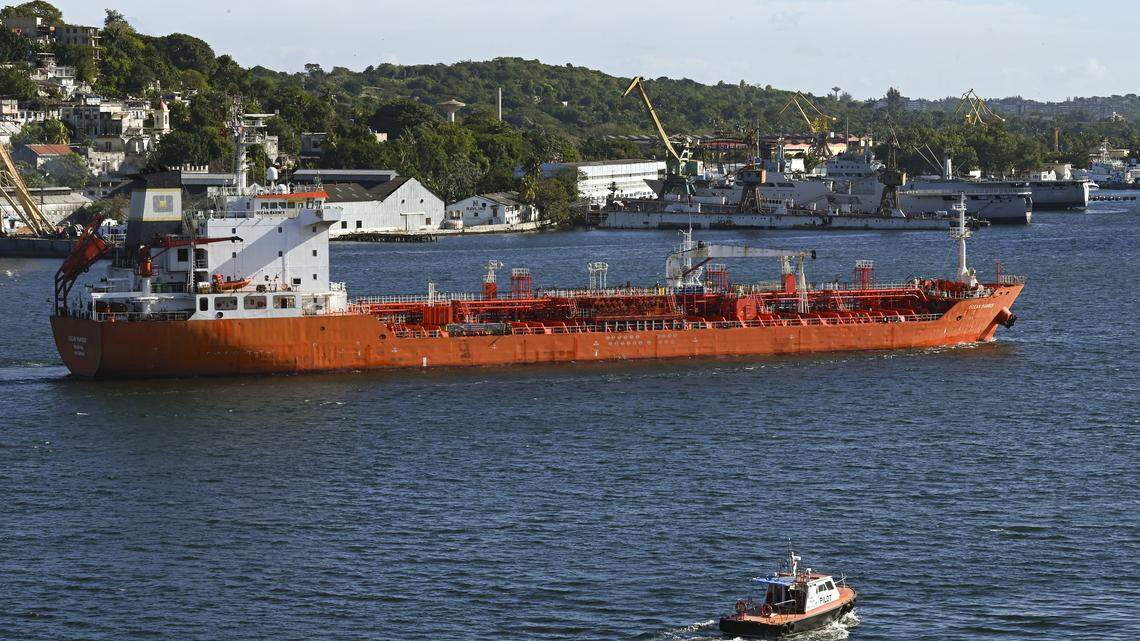
About 190,000–200,000 barrels of Russian diesel on the Hong Kong‑flagged Sea Horse and roughly 700,000 barrels of crude on the sanctioned Anatoly Kolodkin may be headed to Cuba amid an effective U.S. maritime blockade and Coast Guard cutters positioned off the island. Enforcement uncertainty (reports of AIS 'spoofing' and unclear U.S. directive on Cuba) creates regional energy‑logistics and geopolitical risk—blocking shipments risks escalation with Russia while allowing them would undermine U.S. pressure, but the volumes involved are limited relative to global oil supply.
Enforcement ambiguity is creating a short, sharp shock to maritime risk premia: expect spot tanker dayrates for MR/Handy sizes servicing the Caribbean corridor to reprice higher by 20–40% over the next 4–8 weeks as owners demand premium for inspection risk, reflagging, and longer voyages for transshipment. Insurers and P&I clubs will price that uncertainty into voyage costs immediately — add an incremental $0.5–$1.5/bbl to clandestine cargo economics, which in turn widens the arbitrage for using smaller, older tonnage and incentivizes more transshipment activity at sea. On refined product markets, limited local refining flexibility means disruptions manifest as diesel/ULSD tightness within days but take weeks to fully alleviate even after crude availability returns; a reasonable scenario is a 2–6 week window of elevated cracks where nearby ULSD spreads widen by $3–6/bbl if inspections reduce tanker throughput. That timing creates asymmetric outcomes: short-dated derivative positions capture the spike; longer-dated contracts are vulnerable to policy reversals or negotiated humanitarian corridors that can unwind the premium in days. Geopolitical tail risks are binary and front-loaded: an explicit enforcement order or a negotiated exemption each has the power to reverse price signals within 48–72 hours. The second-order corporate winners are owners and operators of flexible tanker capacity and insurers; losers are small refineries and logistics-dependent importers who cannot pivot supply quickly. Monitor three catalysts on a daily cadence — an explicit policy directive, a confirmed clandestine offload, and material moves in P&I/insurance premium notices — as each will reprice markets sharply.
AI-powered research, real-time alerts, and portfolio analytics for institutional investors.
Overall Sentiment
strongly negative
Sentiment Score
-0.70
