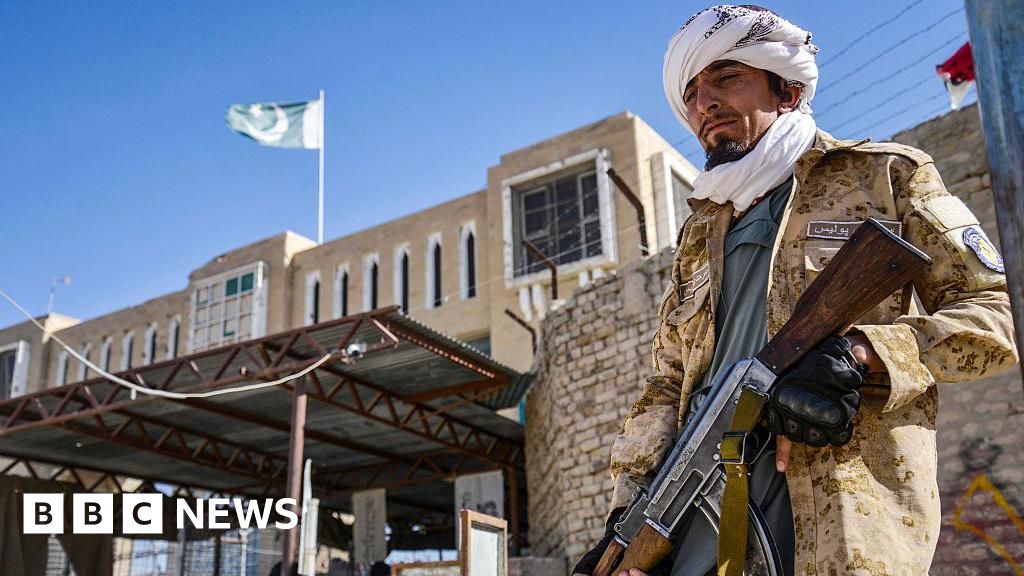
Overnight border clashes erupted between Pakistan and Afghanistan's Taliban forces along the Spin Boldak frontier after each side accused the other of breaking a fragile ceasefire; residents fled the area and footage showed mass displacement. A Kandahar hospital received four bodies and four wounded, while three people were reportedly wounded in Pakistan after roughly four hours of exchanged fire that started around 22:30 local time; both sides blame the other for initiating the attack. The incident comes less than two months after a Qatar- and Turkey-mediated ceasefire, follows recent Saudi-hosted talks that failed to reach agreement, and amplifies regional security risks (ACLED reports ~600 attacks by the Pakistan Taliban on Pakistani forces in the past year), which could pressure investor sentiment toward Pakistani and neighboring emerging-market assets.
Market structure: Immediate winners are safe-haven assets (USD, gold) and regional security/defense plays; immediate losers are Pakistan local assets — equities, banks, sovereign bonds — and frontier EM ETFs with Pakistan exposure. Expect FX stress (PKR weaker), higher Pakistan sovereign yields (spot widening of 100–300bps realistic), and equity-volume spikes as investors reprice political risk; commodity demand impacts are negligible beyond a short-lived risk premium in oil/gas if escalation threatens transit routes.
Risk assessment: Tail risks include a major cross-border operation or air campaign that triggers IMF covenant breaches, capital controls, or sanctions; probability low-medium but impact high (sovereign default or >500bps CDS widening). Timeline: days — FX and intraday equity shocks; weeks–months — sovereign spreads and foreign investor flight; quarters — project delays for infrastructure (CPEC) and lower FDI for 6–24 months. Hidden dependency: IMF program progress and Saudi/Qatari mediation are binary catalysts that can restore flows quickly if resolved.
Trade implications: Tactical short Pakistan exposure and buy protection: short PAK ETF (VanEck PAK) 2–4% NAV with 3-month 5–10% OTM put spread to cap premium; buy Pakistan 5y CDS if spreads breach +200bps vs prior; go long USD/PKR 3-month forward (1–2% NAV) if PKR moves -2–3%. Increase 1–2% allocation to GLD as convex hedge and shift 2–4% from EM equity buckets into 3–12 month U.S. T-bills until volatility normalizes.
Contrarian angles: Consensus assumes protracted disorder; history (2019 skirmishes, 2021 border flare-ups) shows many episodes resolve in 1–3 months once mediators engage, producing rapid recoveries of 20–40% in beaten-down local assets. If PAK ETF falls >30% and Pakistan 5y CDS retraces to <300bps within 60–90 days, initiate phased 3–6 month long positions (mean-reversion trade) but size at distressed thresholds to avoid sovereignty risk.
AI-powered research, real-time alerts, and portfolio analytics for institutional investors.
Request DemoOverall Sentiment
moderately negative
Sentiment Score
-0.35
