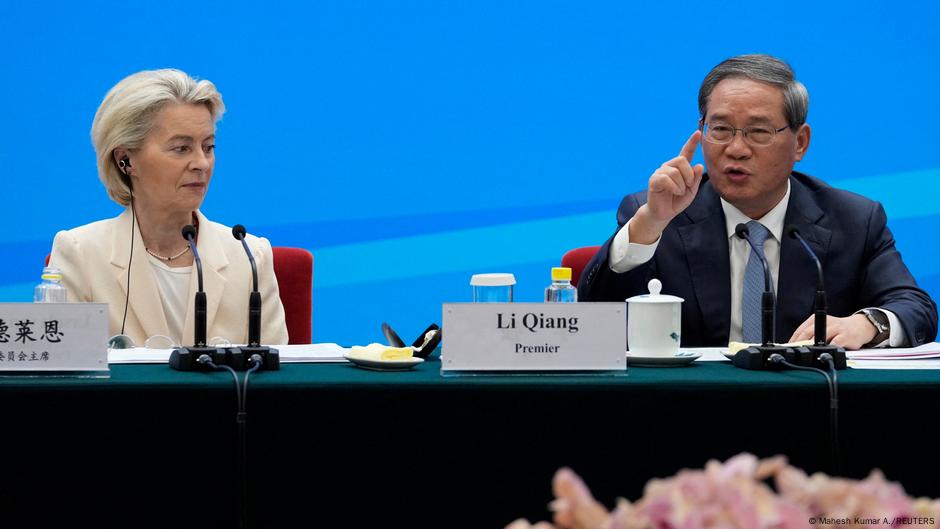
The recent EU-China summit in Beijing underscored deepening geopolitical and trade tensions, yielding minimal progress on core EU concerns such as China's export surplus and its alleged support for Russia's war in Ukraine. While EU leaders pressed for "real solutions" to trade imbalances, Beijing denied fundamental conflicts and urged open markets, with modest agreements only on climate and an "upgraded export supply mechanism" for rare earth materials. This outcome reflects a likely long-term strategic struggle for Europe, as China, driven by domestic overcapacity, seeks to maintain crucial market access and leverage critical mineral controls against potential EU tariffs on its electric vehicles.
The recent EU-China summit in Beijing failed to de-escalate tensions, instead highlighting a deepening strategic divergence on trade and geopolitics. EU leadership directly confronted China over its significant export surplus, which they termed an "inflection point," and its alleged support for Russia's war economy, a point underscored by the EU's recent sanctioning of Chinese entities. Beijing's response was to deny fundamental conflicts, advocate for open markets, and leverage its strategic assets. The agreement to establish an "upgraded export supply mechanism" for rare earths is a minimal concession that does little to ease Europe's concerns, especially as it follows China's move to tighten export controls. This action is likely a strategic maneuver by Beijing, which is grappling with 33 months of deflation and industrial overcapacity, to deter potential EU tariffs of up to 45% on Chinese electric vehicles. The summit's outcome, viewed as a confirmation that relations are unlikely to improve, signals a period of sustained friction and reinforces the need for a more robust European de-risking strategy.
AI-powered research, real-time alerts, and portfolio analytics for institutional investors.
Overall Sentiment
strongly negative
Sentiment Score
-0.60
