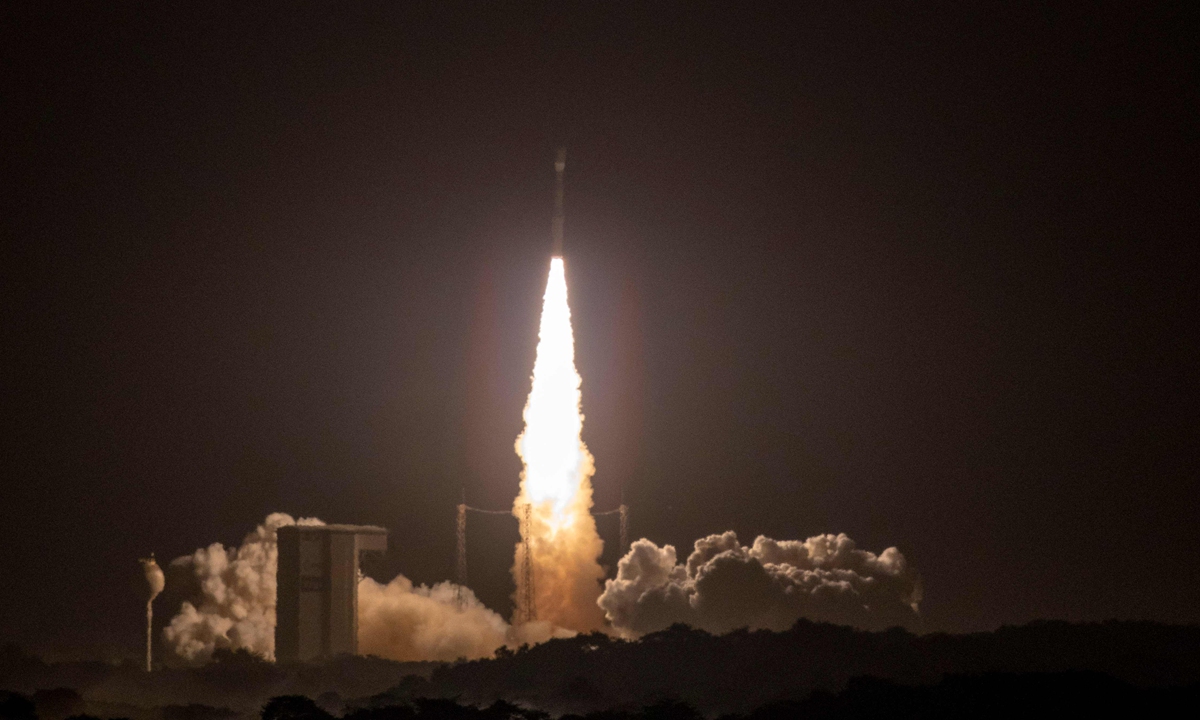
The SMILE satellite launched successfully aboard Vega-C on May 19, 2026, marking China’s first mission-level, in-depth space science cooperation with ESA and a new milestone in China-Europe aerospace collaboration. The mission will use new X-ray imaging technology to study solar wind-magnetosphere interactions, with China and Europe sharing payload and flight-control responsibilities. While highly positive for the partners and the broader space-science ecosystem, the immediate market impact is likely limited.
This is less a single-mission story than a signal that China has moved from “participant” to “systems integrator” in high-end civil space. The investment implication is that the bottleneck is shifting from launch and platform know-how toward payload software, ground-segment integration, autonomous operations, and dual-use data services — areas where Chinese firms can now compound value without needing Western primes as the centerpiece. NSSC’s role is strategically important because it increases domestic control over mission architecture, which usually translates into better bargaining power on future international programs and faster monetization of downstream applications. The second-order effect is on ecosystem breadth: a successful cross-border mission lowers the perceived execution risk for future China-led constellations and data products, especially in Earth observation and space weather-adjacent analytics. That matters because the next wave of value creation will not be in one-off flagship missions, but in repeatable, lower-cost cluster deployments with software-defined payloads and AI-enabled tasking. If China can demonstrate reliable mixed-control operations with Europe, it improves its exportability into Belt-and-Road markets that care more about service uptime than political provenance. The market is likely underpricing the service layer while overpricing the headline prestige layer. Near term, the catalyst is reputational: successful orbit-raising and joint operations validate Chinese propulsion, ground control, and payload integration capabilities over the next several months, which should help procurement and partnership discussions. The main risk is that any anomaly during the extended maneuver phase would expose the fragility of multi-party mission control and temporarily cool appetite for collaborative constellations, but that is a months-to-quarter risk, not a days-only event. Contrarian takeaway: the most meaningful beneficiary may not be the obvious aerospace hardware names, but firms positioned to package space data into defense, climate, maritime, and telecom workflows. If the CATCH-style model gets traction, the economics shift from capex-heavy project work to higher-margin recurring services, which is where the rerating potential sits.
AI-powered research, real-time alerts, and portfolio analytics for institutional investors.
Request DemoOverall Sentiment
strongly positive
Sentiment Score
0.72
Ticker Sentiment
