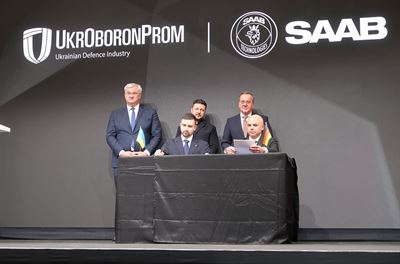
Saab and Ukraine's Joint Stock Company “Ukrainian Defense Industry” signed a Memorandum of Understanding at the Munich Security Conference 2026 to collaborate on aviation and airborne surveillance capabilities aimed at strengthening Ukraine's defence sector. JSC UDI, a consolidator of state defence enterprises, will partner with Saab — which is contributing aviation and surveillance expertise — potentially laying groundwork for future procurement, technology transfer or contracts, though the MoU contains no near-term financial commitments.
Market structure: This MoU is a low‑nearterm‑impact but high‑signal event that preferentially benefits Saab (SAAB‑B.ST) and European defense primes (BAES.L, LDO.MI, RTX, LMT) by enlarging addressable demand for airborne surveillance and avionics. Expect modest market share gains for firms that can localize production in Ukraine and verticalize supply chains; pricing power improves for niche sensor/electronics suppliers but will be constrained until firm orders materialize (likely 6–24 months).
Risk assessment: Tail risks include export‑control blocks, IP loss, escalation of conflict, or cancellation if Western aid stalls — each could wipe 20–60% of near‑term upside for players dependent on Ukraine programs. Immediate (days): negligible market moves; short (3–12 months): JV structuring and export licences determine re‑rating; long (2–5 years): actual production, tech transfer and recurring orders drive revenues. Hidden dependencies: Western funding tranches, NATO interoperability requirements, skilled labor availability and insurance/supply‑chain resilience.
Trade implications: Direct tactical plays are concentrated European defense names and sector ETFs (ITA, XAR) with optionality: establish small equity exposure now (1–3%) and buy 12–18 month call spreads to asymmetrically capture contract flow over 6–18 months. Relative trades: long Saab/BAE vs short commercial airframe OEMs (Airbus EADSY or BA) to isolate defense upside; increase commodity/steel allocations only if program adjudication signals sustained procurement (>€1B+ programs).
Contrarian angles: The market is underpricing execution and funding risk — consensus treats MoU as certain future revenue when historically 40–60% of defense MoUs don't convert quickly. Historical parallel: post‑2014 Europe rearmament led to 30–60% multi‑year outperformance for focused defense names, but only after concrete contracts and sovereign financing; downside is tech transfer could create future regional competitors, compressing margins over 3–5 years.
AI-powered research, real-time alerts, and portfolio analytics for institutional investors.
Request DemoOverall Sentiment
mildly positive
Sentiment Score
0.25
