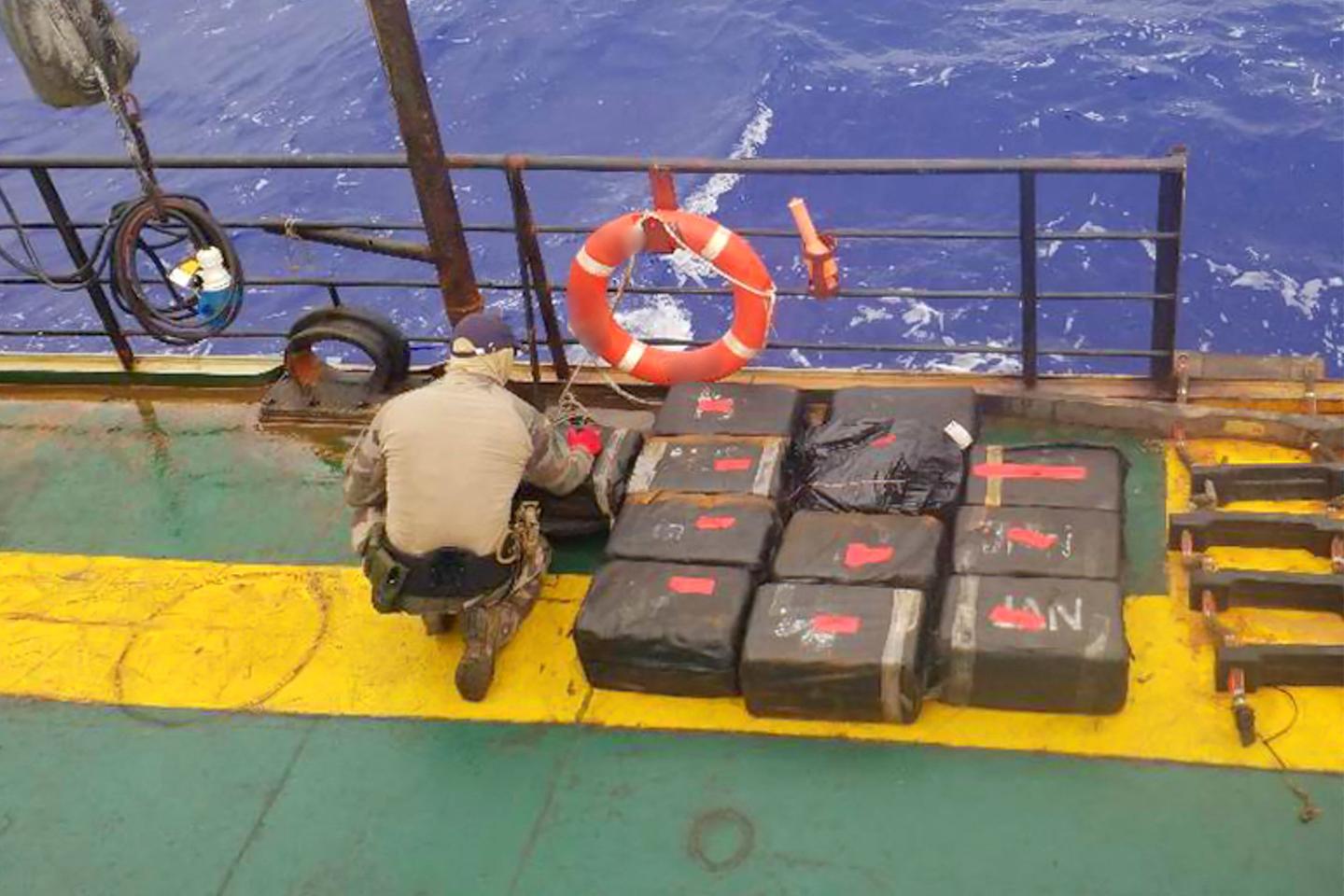
France's navy intercepted a Central American vessel in French Polynesia on Feb. 4 and seized 4.25 metric tons of cocaine believed bound for South Africa; the cargo was destroyed at sea and the vessel and crew were released under international law after prosecutors declined to bring local charges. The seizure—coming after a nearly 5-ton haul last month—aligns with U.N. findings that organized crime has expanded cocaine and methamphetamine trafficking across Pacific maritime routes toward Australian and New Zealand markets, raising regional security and shipping-insurance considerations.
Market structure: This incident signals incremental but persistent demand growth for maritime domain awareness, interdiction platforms and imagery analytics rather than a one-off shock. Winners: defense/aerospace primes and specialist ISR and satellite-imagery vendors (e.g., L3Harris LHX, Lockheed LMT, Maxar MAXR) that sell patrol sensors, maritime radars and analytics; losers: small regional shipping operators and flag-of-convenience carriers (e.g., ZIM) that face higher inspection/compliance frictions and insurance costs. Cross-asset: expect modest re-pricing in select equities and specialized credit (marine insurers/reinsurers), negligible immediate move in rates/FX/commodities except potential AUD/NZD sensitivity on regional security headlines.
Risk assessment: Tail risks include rapid geopolitical escalation in the Pacific (low-probability) that could trigger tariffs/sanctions and disrupt trade lanes, and policy risk if European/French legal limits constrain interdiction effectiveness. Time horizons: immediate (days) = headline volatility; short-term (weeks–months) = procurement signals and tender announcements; long-term (1–3 years) = CAPEX cycles for maritime surveillance. Hidden dependencies: demand hinges on Australia/France/US budget allocations and bilateral aid (thresholds: combined regional maritime procurement >$200m/year materially lifts vendor revenues). Catalysts: defense budget releases, large procurement RFPs, or a major interdiction linked to organized crime that draws national investment.
Trade implications: Prefer concentration in higher-margin ISR and systems integrators over commodity shipping names. Tactical: overweight A&D/ISR exposure via ETFs (ITA) and select names (LHX, MAXR, LMT) with 6–18 month horizon to capture procurement cycles; small tactical short on exposed regional carriers (ZIM) for 3–6 months to capture margin pressure from compliance/insurance headwinds. Options: use defined-risk call spreads on LHX or MAXR 3–6 month expiries to leverage procurement beat potential while capping downside.
Contrarian angles: Consensus will underweight steady, low-visibility Pacific security spend versus headline Europe/Ukraine spending; that underappreciation creates mispricing in small-cap ISR and satellite pure-plays. Reaction so far is underdone — buy-side can accumulate before tender announcements; historical parallel: Caribbean interdiction build-outs (2010–15) delivered multi-year sustainment contracts to a handful of systems integrators. Unintended consequence: successful interdiction can shift criminal channels to cyber/air routes, boosting demand for maritime-analytics + adjacent cybersecurity providers.
AI-powered research, real-time alerts, and portfolio analytics for institutional investors.
Request DemoOverall Sentiment
neutral
Sentiment Score
0.00
