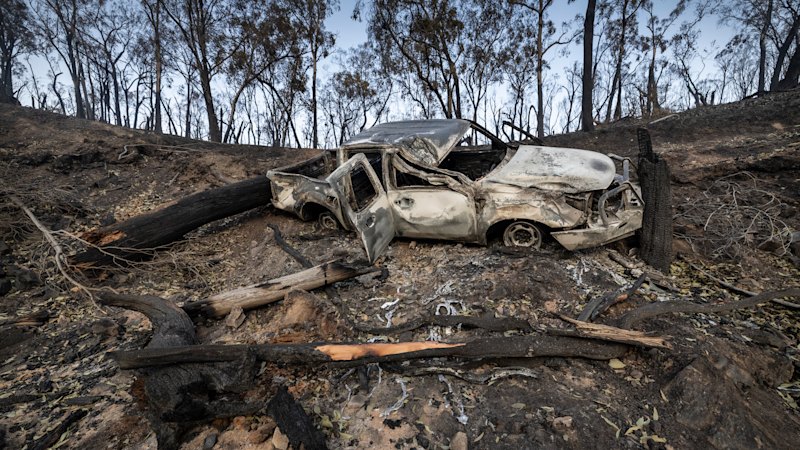
Widespread bushfires across Victoria continue to burn 27 active blazes that have blackened roughly 395,100 hectares, destroyed more than 300 structures and killed at least one person; major fires remain uncontrolled in Walwa and the Otway Ranges. Significant local economic damage includes a 10,000-hectare pine plantation razed, vineyards and livestock losses, and concentrated property losses in Longwood, Ravenswood, Natimuk and other towns; several fires could persist for weeks. Authorities have issued widespread evacuation and shelter warnings and the federal and state governments announced an additional A$19.5 million for affected communities (about half earmarked for hay distribution, remainder for emergency accommodation and mental-health support), a limited fiscal response that may partly mitigate short-term agricultural and relief costs. Persistent poor air quality and ongoing fire danger elevate regional operational and insurance risks for agricultural commodities, timber, and local real estate exposure.
Market structure: Near-term winners are building-materials and heavy construction suppliers (BLD.AX, CSR.AX, BSL.AX) and agricultural feed/grain handlers (GNC.AX, RIC.AX) because ~400,000 ha burned implies multi-year rebuilding and hay/feed demand; losers are regional property owners, timber plantation owners and primary-line insurers (IAG.AX, QBE.AX, SUN.AX) facing concentrated claims. Pricing power shifts to materials suppliers as local timber and hay supply tightens; expect upward pressure on lumber/hay prices of 10–30% in next 3–9 months regionally.
Risk assessment: Tail risks include a prolonged fire season or consecutive poor harvests that magnify agricultural shortfalls and push AUD down >3% (low-probability, high-impact), regulatory interventions capping insurance premiums, and a reinsurance market hardening at Jan–Mar renewals raising insurer costs. Immediate (days) impacts are claims/volatility spikes; short-term (weeks–months) are supply-chain bottlenecks and input cost rises; long-term (years) are higher insurance pricing and migration of capital away from high-fire-risk real assets.
Trade implications: Favor 6–12 month long positions in large-cap materials (BLD.AX, CSR.AX) and grain handlers (GNC.AX) sized 1–3% NAV each; hedge insurance earnings risk by shorting or buying puts on IAG.AX/QBE.AX (0.5–1% NAV). Use options to express asymmetric risk: buy 3–6 month call spreads on BLD/CSR and 1–3 month ATM puts on IAG; consider pair trade long BLD.AX / short IAG.AX given divergent fundamentals.
Contrarian angles: Consensus may over-penalize insurers; if reinsurance pricing normalizes after renewals, QBE (global reinsurer exposure) could recover — consider opportunistic accumulation on >15% drawdowns with 12–18 month horizon. Conversely, rebuilding demand can lift CPI regionally and force RBA tightening, which would hurt duration-heavy assets — avoid long-duration REITs exposed to regional housing for 6–12 months.
AI-powered research, real-time alerts, and portfolio analytics for institutional investors.
Request DemoOverall Sentiment
moderately negative
Sentiment Score
-0.60
