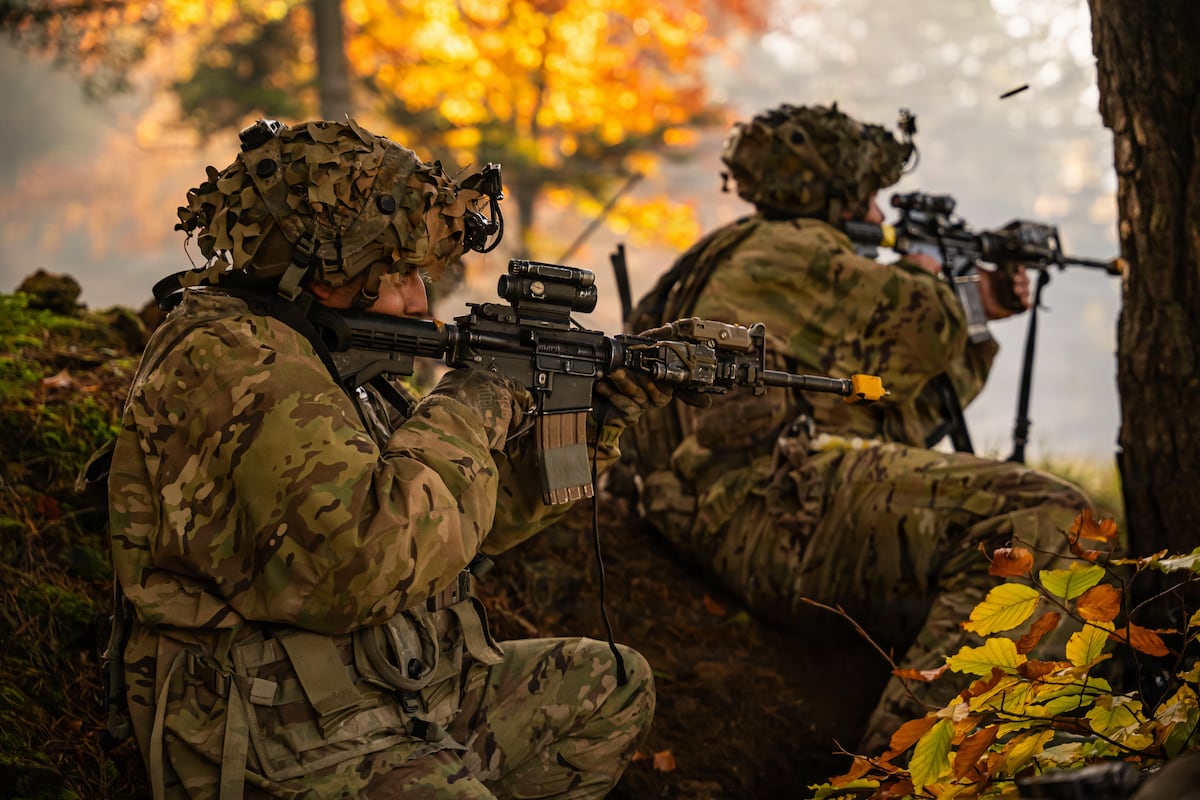
U.S. Army officers in Germany emphasized the strategic value of the roughly 35,000 U.S. active-duty troops stationed there, including deterrence, NATO interoperability and lessons from Ukraine, after President Trump said he was reviewing troop levels. The article highlights Germany’s role as the U.S. military’s largest European footprint and Hohenfels’ importance as a combat training hub. The piece is largely factual and does not indicate an immediate policy change or direct market catalyst.
The immediate market read is not about headline troop counts; it is about the implied policy regime for European deterrence spending. Even a modest repositioning talk raises the probability that Germany and front-line NATO states accelerate procurement in air defense, counter-UAS, EW, ammunition, and logistics stockpiles over the next 6-18 months, because governments will want to reduce dependence on U.S. force posture uncertainty. The second-order winner is the defense supply chain in Europe and the U.S. primes with exportable systems and fast production capacity, while the loser is any supplier concentrated in legacy heavy armor or slow-cycle platforms that do not map cleanly to drone/EW lessons. The training angle matters more than the troop-count angle. The real signal is that Ukraine-derived tactics are being institutionalized into NATO doctrine, which should compress the procurement cycle for counter-drone sensors, jamming, hardened communications, and software-defined battlefield tools. That favors firms with recurring revenue from software, sensors, and integration rather than one-time hardware sales; it also benefits ammunition and spare-parts vendors because a more contested electromagnetic environment drives higher attrition and lower equipment availability. Over months, this can lift sustainment budgets even if headline troop levels are unchanged. Contrarian risk: the market may overestimate near-term troop reductions and underweight bureaucratic inertia. Large force-structure changes are slow, politically sticky, and likely offset by rotational deployments, prepositioned equipment, and budget reallocation rather than a clean exit, so the first-order selloff in European defense proxies could be faded if no concrete decision arrives within weeks. The bigger tail risk is not fewer troops but a sharper shift toward distributed, autonomous, and electronic-warfare-heavy force design, which would pressure contractors exposed to expensive legacy platforms and reward those with low-cost attritable systems and mission software.
AI-powered research, real-time alerts, and portfolio analytics for institutional investors.
Request DemoOverall Sentiment
neutral
Sentiment Score
0.00
