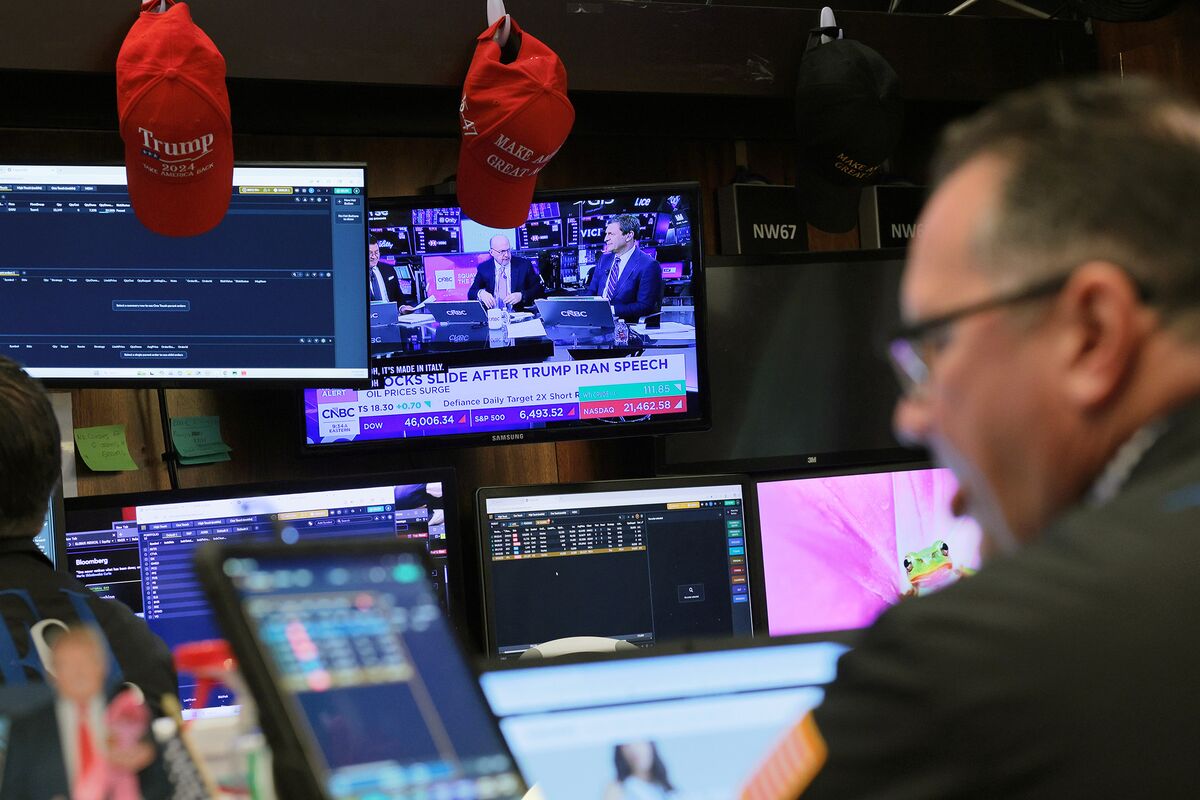
President Trump's prime-time address on the Iran war signaled a longer conflict and did not reassure markets, leaving investors and consumers jittery. The tone may increase risk aversion and pressure on risk assets and consumer spending, while separate notes in the piece flag tariff-refund issues and product-development commentary for select sectors. Expect short-term volatility around geopolitical headlines rather than an immediate market-moving policy shock.
Price action is behaving like a policy-uncertainty shock rather than a pure geopolitical one: flows are moving into duration and real assets while risk assets reprice conditional volatility. Historically, headline-driven uncertainty of this type widens IG spreads by ~10–25bp and can lift the 10Y yield volatility by 40–60% in the first 30 days, which compresses leveraged discretionary margins and raises funding costs for buyouts and small caps.
The most actionable second-order effects are on energy shipping/insurance costs and consumer discretionary demand. A localized escalation that threatens Strait-of-Hormuz transits typically embeds an incremental $8–$18/bbl risk premium in Brent within weeks via higher war-risk insurance and rerouting; that raises jet fuel and freight input costs, compressing airline and retailer margins by low-single-digit percentage points over 1–3 quarters unless hedged.
Time horizons matter: expect headline-driven VIX spikes in days–weeks; commodity and insurance repricing over weeks–months; structural shifts (reshoring, defense budget reallocation) over 6–36 months. Reversal catalysts that would rapidly unwind risk premia are credible diplomatic engagement, a de‑escalation framework with measurable steps, or a convincing election-related policy clarification — any of which has historically cut the headline risk premium by 40–60% within 30–90 days.
The consensus leans toward blanket defense longs and blanket retail shorts; that’s over-simplified. Defense equities often price a forward premium quickly, so option-based directional exposure or event-timed pairs offer better asymmetry. Meanwhile, consumer demand dips are typically shallow and mean-reverting over two quarters, so avoid large-cap retail outright shorts unless paired with protective hedges.
AI-powered research, real-time alerts, and portfolio analytics for institutional investors.
Request DemoOverall Sentiment
mildly negative
Sentiment Score
-0.25
