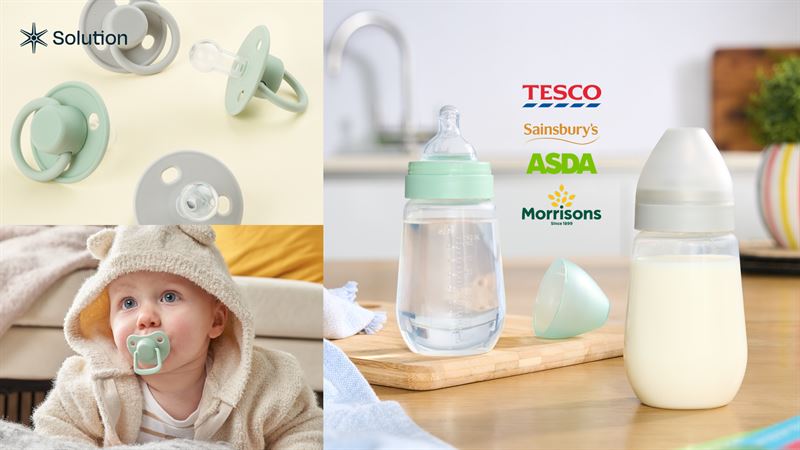
Solution International has strengthened its UK footprint by supplying baby bottles and soothers to the four largest grocery retailers — Tesco, Sainsbury’s, ASDA and Morrisons — highlighting BPA-free materials, anti-colic technology and ergonomic design. Strategically headquartered in the UK with in-house product development, marketing and its own warehouse, the company emphasizes improved distribution and end-to-end supply-chain control, positioning it to capture incremental growth in the UK baby feeding category; no financials or revenue guidance were disclosed.
Market structure: Solution International's expanded placement with Tesco (TSCO.L), Sainsbury's (SBRY.L), ASDA and Morrisons (MRW.L) primarily benefits mid-market grocery retailers and niche private-label/upstream suppliers able to meet safety/compliance specs. Expect modest category share gains for compliant, innovation-led suppliers and a 1–3% uplift in baby-feeding unit sales for participating grocers over 12 months if promotional intensity increases; smaller low-cost/low-quality suppliers are losers as buyers tighten standards.
Risk assessment: Key tail risks are product recall/regulatory change on BPA/chemical standards or a logistics disruption (warehouse/UK port) causing large SKU shortages; a recall could wipe out a supplier’s revenue stream (>50% short-term loss). Immediate risk (days) is minimal; short-term (weeks–months) watch inventory turns and promotional cadence; long-term (quarters–years) monitor whether incumbent suppliers scale without margin erosion. Hidden dependency: retailer buying power — grocers can squeeze supplier margins despite higher volumes.
Trade implications: Tactical long exposure to UK grocers (TSCO.L, SBRY.L) captures stable distribution gains; consider 1–2% position sizes with 3–6 month horizon, as category tailwinds are gradual. For suppliers, prefer large consumer staples with diversified baby portfolios (PG, KMB) via 3–9 month call spreads to limit capital while capturing premiumization upside; small-cap bespoke suppliers without diversified channels are avoid/short candidates if identified.
Contrarian angles: Consensus may overstate sustainable pricing power of innovative suppliers — retailers can force commoditization via own-brand launches, compressing supplier margins by 200–400bps over 12–18 months. Historical parallels: premium baby categories (anti-colic, BPA-free) initially lift supplier top-lines but ultimately draw private-label competition. Unintended consequence: wins at scale can increase supplier working capital needs and capex, pressuring free cash flow and credit metrics.
AI-powered research, real-time alerts, and portfolio analytics for institutional investors.
Request DemoOverall Sentiment
mildly positive
Sentiment Score
0.25
