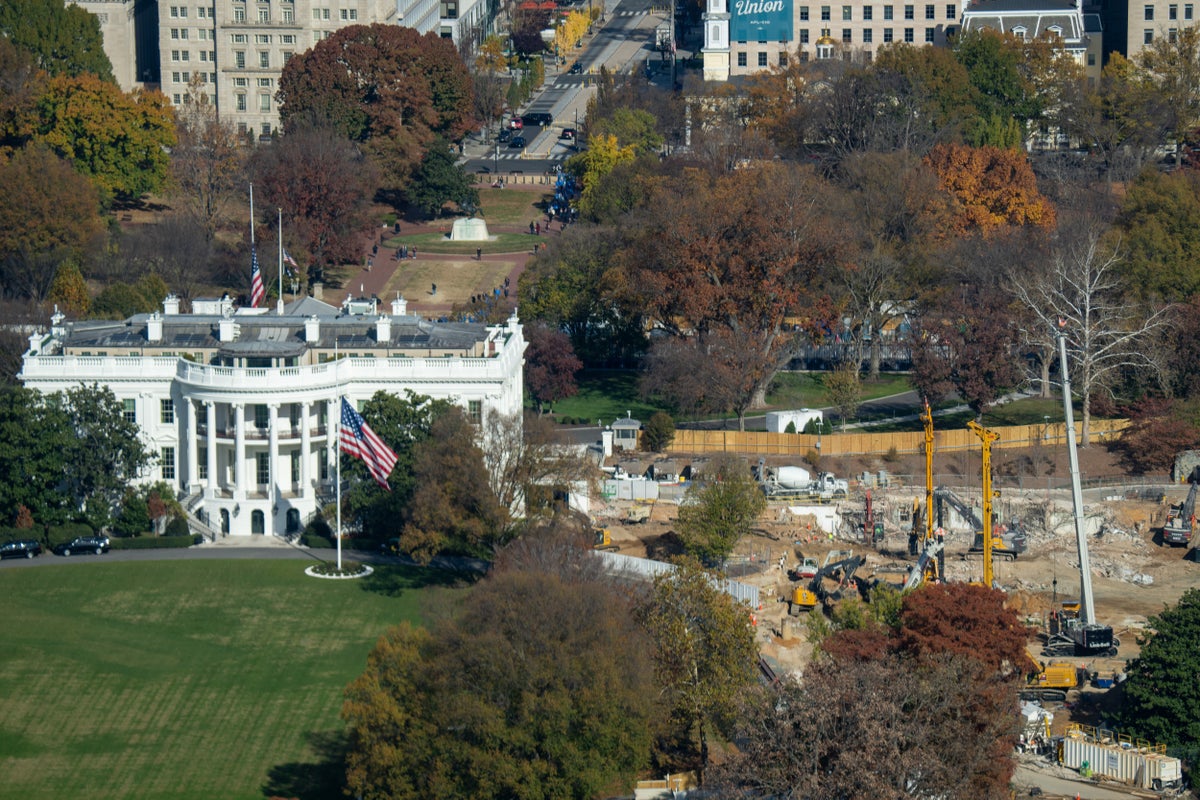
A U.S. appeals court allowed Trump's $400 million White House ballroom construction to continue temporarily until April 17, reversing a lower court stop order for now. The dispute centers on whether the project exceeded presidential authority and whether congressional approval is required, despite Trump's claim that it is privately funded and tied to White House security. The ruling is an interim legal development with limited direct market impact.
This is a governance and administrative-law micro-shock, not a macro event, but it has one important second-order effect: it increases the probability that federal real-estate and construction decisions become a litigation battleground whenever they can be framed as executive power overreach. That raises optionality for preservation groups, contractors, and donors to stall or accelerate politically sensitive projects, while making the eventual legal standard more important than the underlying building itself. The market read-through is that headline risk can persist for weeks, but cash-flow impact is likely negligible unless the dispute broadens into procurement, permitting, or donor-concentration issues.
The nearer-term investable implication is on contractors, specialty subcontractors, and adjacent suppliers that can be caught in stop-start execution if the project is frozen again. The biggest hidden risk is not direct loss of revenue; it is schedule slippage that can push milestone payments, force remobilization costs, and create margin leakage on a project that is already politically overfit. If the court ultimately demands legislative approval or a formal environmental/preservation review, the timeline could stretch from months to years, which would favor firms with diversified backlogs and hurt names dependent on high-profile discretionary work.
The contrarian angle is that the current market may be overpricing the legal drama while underpricing the signaling value: if the project proceeds, it strengthens the practical durability of privately funded, executive-driven construction on federal property. That could matter for future contracts where political access and donor networks compress decision cycles, creating a subtle tailwind for certain construction, security, and AV integration vendors. The reverse tail risk is a hard injunction that forces a public rollback; that would not just delay the ballroom, it would embolden challenges to other non-core federal renovations and make politically exposed construction more expensive to underwrite.
AI-powered research, real-time alerts, and portfolio analytics for institutional investors.
Request DemoOverall Sentiment
neutral
Sentiment Score
-0.05
