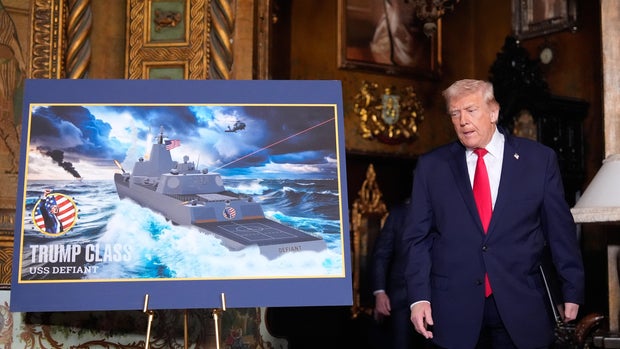
President Trump announced approval to begin construction of a new “Trump-class” battleship program, initially authorizing two very large vessels with an expected build time of roughly 2.5 years and ambitions to build 10 in the near term and ultimately 20–25. The Navy and administration officials framed the plan as a generational investment tied to bolstering the U.S. shipbuilding supply chain and naval presence in Latin America amid tensions with Venezuela; specifics on funding, procurement contracts, and congressional approval were not provided. For investors, the announcement signals potential upside for U.S. shipbuilders and defense contractors if funded, but the lack of concrete budgetary detail and timelines limits immediate market-moving implications.
Market structure: direct winners are U.S. shipbuilders and upstream metal/engine suppliers; primary beneficiaries include Huntington Ingalls (HII) and General Dynamics (GD) for surface combatant construction and lead yards, plus steel producers (NUE, X) and marine engine/avionics suppliers. Losers: defense programs competing for finite DoD dollars (space/air budgets) and non-U.S. shipbuilders who lose export opportunities. Expect pricing power for shipyards and tier-1 suppliers: backlog growth could push yard utilization from ~60% to >80% over 18–36 months, supporting 10–20% revenue upside for select names if funded.
Risk assessment: tail risks include program cancellation or Congressional reallocation (probability 15–25%) and cost overruns that could double per-ship cost (>+$5–10bn each), squeezing margins and triggering writedowns. Time windows: immediate (days) = event-driven equity moves; short-term (3–9 months) = NDAA/appropriations and contractor re-rate; long-term (2–5 years) = construction cadence, supply-chain capacity and margin realization. Hidden dependency: shipbuilding constrained by skilled labor and drydock capacity — supply choke can delay revenue recognition and inflate costs.
Trade implications: tactical long exposure to HII (direct yard) and GD (Bath Iron Works) with 3–6 month options to capture re-rate ahead of budget votes; pair trade long HII/GD vs short Lockheed (LMT) or RTX to favor shipbuilders over aero primes. Macro plays: modest short-duration Treasury position (buy 3–6 month TLT puts or short 7–10y futures) to hedge fiscal financing risk; commodities long (NUE, X) on 6–18 month horizon as steel demand rises. Entry: scale into positions on pullbacks of 5–10% and add on confirmed FY funding language in NDAA.
Contrarian angles: consensus assumes smooth funding and rapid builds — more likely is phased appropriations, multi-year buys and offsets hurting other defense buckets, so market may over-reward headline names now. Historical parallel: 1980s Reagan shipbuilding surge shows forward orders lag political announcement by 6–18 months; mispricing window exists if Congress delays funding. Unintended consequence: accelerated domestic sourcing drives inflation in wages/steel, compressing margins for non-contracted yards and creating spread opportunities between contracted (fixed-price) and cost-plus contractors.
AI-powered research, real-time alerts, and portfolio analytics for institutional investors.
Request DemoOverall Sentiment
mildly positive
Sentiment Score
0.25
