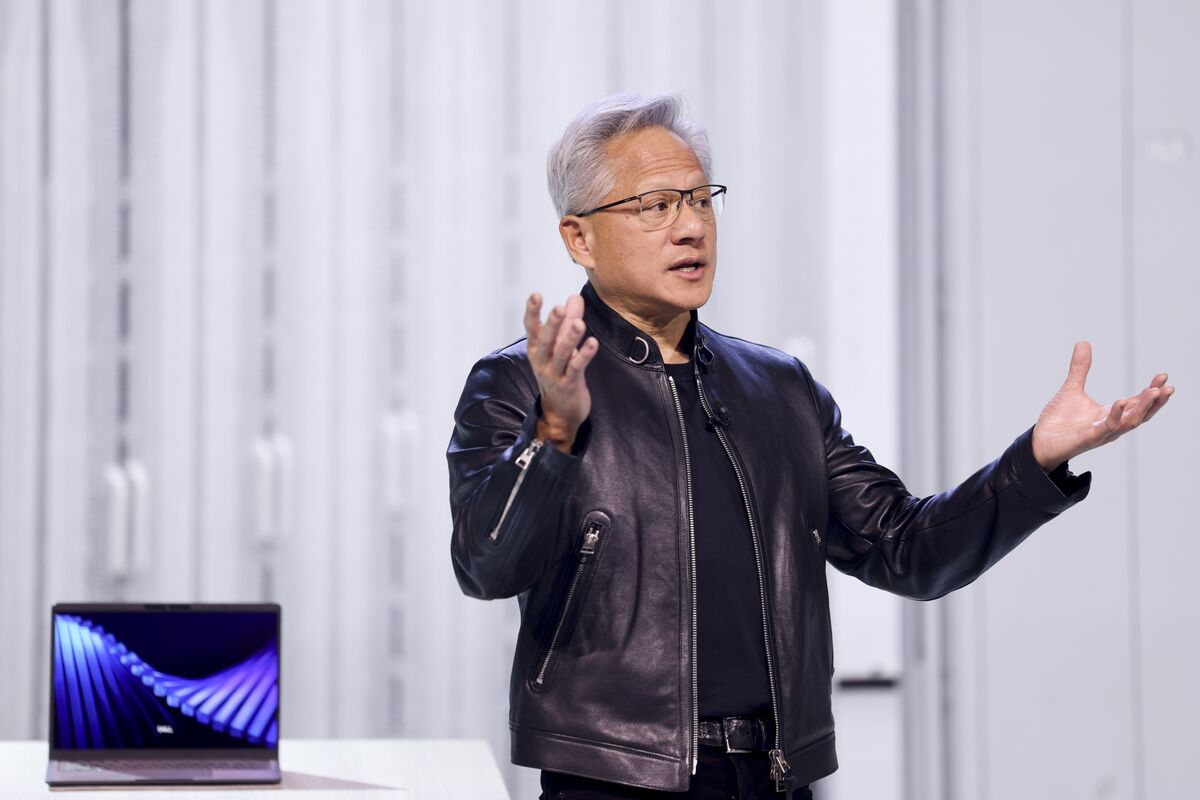
Nvidia CEO Jensen Huang said China’s AI chip market will likely open over time to imports from the US, suggesting eventual access for Nvidia and other American chipmakers. The comments, made after his summit with President Trump in China, imply easing restrictions around AI semiconductor trade, though no policy change has been announced yet. The signal is modestly positive for US AI hardware exposure and Chinese demand, but the immediate market impact appears limited.
The key incremental signal is not near-term revenue, but optionality on China demand normalization for NVIDIA’s installed base and software ecosystem. If even a portion of the Chinese AI buildout reopens to US silicon, the market will likely re-rate the durability of NVDA’s data-center growth path and, more importantly, the terminal value of its software attach and developer lock-in. That helps the whole US AI stack, but NVDA remains the cleanest expression because it benefits from both unit demand and ecosystem reinforcement.
Second-order, a reopening would likely widen the competitive gap versus domestic Chinese chip efforts because it reintroduces a performance benchmark that local vendors must chase while customers still optimize for time-to-train and inference throughput. Over 6-18 months, that can pressure non-US GPU alternatives through lower utilization and weaker pricing power, while also reducing the urgency of buyers to diversify away from NVDA. The bigger winner may be suppliers tied to advanced packaging, HBM, and networking, since any incremental China demand is likely to be served first by the highest-value nodes in the AI supply chain.
The main risk is that this remains a political talking point rather than a policy shift. China can use selective access as bargaining leverage, meaning the market may front-run a headline that never becomes broad license issuance; that creates a classic fade risk over days to weeks. Conversely, if export control rhetoric hardens again, NVDA’s China optionality gets repriced quickly, but the underlying bull case still stands because ex-China demand is the primary driver; the real downside is multiple compression, not a collapse in fundamentals.
Consensus may be underestimating how much of the upside is already in “no news is bad news” positioning. A modest relaxation would be enough to force systematic funds to add exposure, because the change is less about current China revenue and more about extending the market size assumption embedded in long-duration AI capex models. That makes the asymmetry attractive: limited incremental downside if talks stall, but meaningful upside if policy inches toward reopening.
AI-powered research, real-time alerts, and portfolio analytics for institutional investors.
Request DemoOverall Sentiment
mildly positive
Sentiment Score
0.15
Ticker Sentiment
