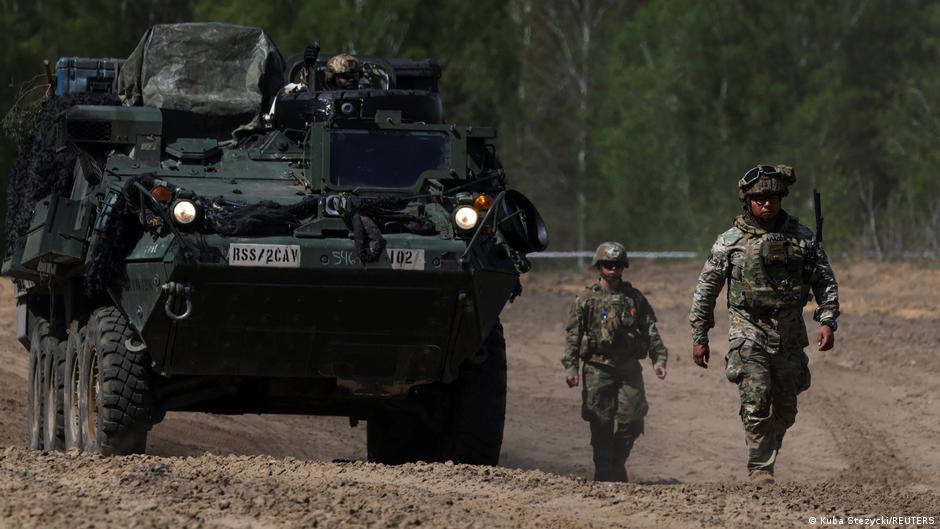
The US will take several years to reduce its military presence in Europe, with NATO commander Alexus Grynkewich saying the withdrawal will be coordinated with allies and limited to capabilities Europe cannot yet replace. Trump’s near-term move is about 5,000 troops from Germany, where the US currently has roughly 50,000 personnel stationed. The comments reinforce a gradual NATO burden-sharing shift rather than an abrupt drawdown, but the geopolitical implications are material for European defense planning.
The market should treat this less as an imminent force-reduction story and more as a multi-year reallocation of burden from the US to Europe. That matters because the first-order fiscal impulse is modest, but the second-order effect is a re-pricing of European defense procurement, logistics, and munitions stockpiles as allies are forced to close capability gaps the US has been subsidizing. The key signal is not troop count itself; it is the sequencing of enablers — ISR, air defense, strike, and command-and-control — which typically drives defense budgets with a 12-24 month lag.
For equities, the relative winners are the suppliers of scarce, high-urgency categories: integrated air defense, missile defense interceptors, electronic warfare, and battlefield communications. The less obvious beneficiaries are European primes and mid-cap subsystem vendors with NATO-qualified production lines, because governments will prefer firms that can expand capacity quickly rather than the cheapest long-cycle platforms. The losers are defense names dependent on US European basing, NATO logistics contracts, and legacy heavy armor exposure if budget mix shifts toward air defense and munitions replenishment.
The main risk is that the trade is becoming consensus too early while the actual withdrawal remains slow and reversible. A change in White House tone, a NATO burden-sharing deal, or a new European security shock could all re-accelerate US presence and delay procurement decisions; meanwhile, the incremental budget uplift may leak into future fiscal cycles instead of hitting orders immediately. That makes the near-term setup more about options on policy uncertainty than outright directional beta.
Contrarian view: the market may be overestimating the pace of European rearmament and underestimating industrial bottlenecks. Even with political will, air-defense and missile production bottlenecks are measured in quarters to years, so the near-term beneficiaries are likely fewer and more concentrated than broad defense baskets imply. The most attractive positioning is to own capacity-constrained winners while fading names that need rapid European capex conversion to justify the move.
AI-powered research, real-time alerts, and portfolio analytics for institutional investors.
Request DemoOverall Sentiment
neutral
Sentiment Score
-0.05
