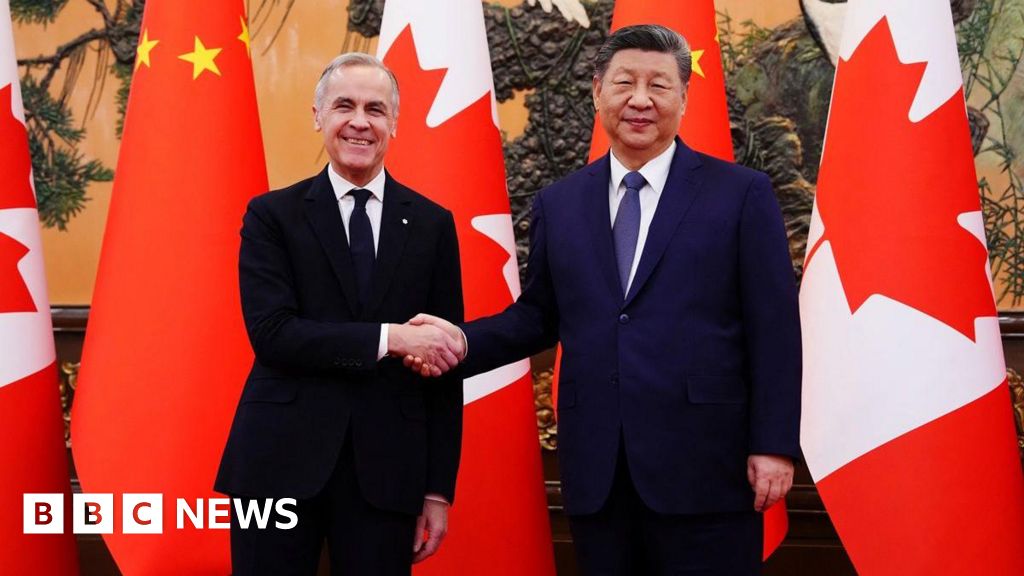
China and Canada agreed to roll back key tariffs after a high-level meeting: China will reduce levies on Canadian canola oil from 85% to 15% by March 1, and Canada will tax Chinese electric vehicles at the most-favoured-nation rate of 6.1% (down from a prior 100% measure). The move represents a bilateral trade reset—following reciprocal tariffs that targeted over $2bn of Canadian farm products—and could boost Canadian agri-exports and reopen EV-related trade and investment channels, while also signaling a potential increase in Chinese investment flows into Canada. Two-way merchandise trade was C$118bn in 2024, underscoring the economic significance of a thaw even as political and human-rights differences remain framed as “red lines.”
Market structure: Immediate winners are Canadian canola growers/processors and Chinese EV OEMs — China cutting canola levies from 85%→15% by 1 Mar implies a material restoration of exports (expect >5–10% incremental volume into China over Q1–Q2 2026 vs 2025 trough). Canadian domestic EV demand will face ~6.1% MFN Chinese imports (from 100%), pressuring pricing power for Tesla (TSLA) and local assemblers while expanding addressable market for BYD (BYDDY) / XPEV (XPEV) in 6–12 months.
Risk assessment: Tail risks include rapid US diplomatic pressure causing Canada to re-tighten tariffs (low probability but high impact) and reputational/regulatory shocks from human-rights incidents that could halt investment flows; model a 10–25% downside shock to Canadian export revenue in such scenarios. Time horizons: pricing moves in commodities and FX within 1–3 months; structural market-share shifts in autos unfold over 6–24 months. Hidden dependencies: Chinese financing of Canadian acquisitions and supply-chain re‑routing could amplify FX and M&A activity.
Trade implications: Direct tactical trades: buy call exposure to ICE canola futures into Mar 1 (expect 8–15% price recovery) and buy 3–6 month calls or call spreads on BYDDY/XPEV to capture market-entry upside; hedge with short TSLA exposure if overweight Chinese EVs. Rotate 1%–2% FX exposure into CAD via 3‑month forwards if CAD strengthens >50bp vs baseline; shift 1–3% from US T-bills into 3–5y Canadian sovereigns if yields compress >20bp on incoming Chinese capital.
Contrarian angles: Consensus underestimates the strategic capital flows — China may use investment to lock supply chains (energy, mining, ag) within 12–36 months, favoring Canadian resource/energy names rather than pure merchants. Reaction may be overdone in short-term political headlines: if markets sell Canadian cyclicals on geopolitics, we see an asymmetric buying opportunity; conversely, the settlement could be reversed quickly if Washington exerts trade pressure — size positions with stop-losses and event triggers.
AI-powered research, real-time alerts, and portfolio analytics for institutional investors.
Request DemoOverall Sentiment
mildly positive
Sentiment Score
0.35
