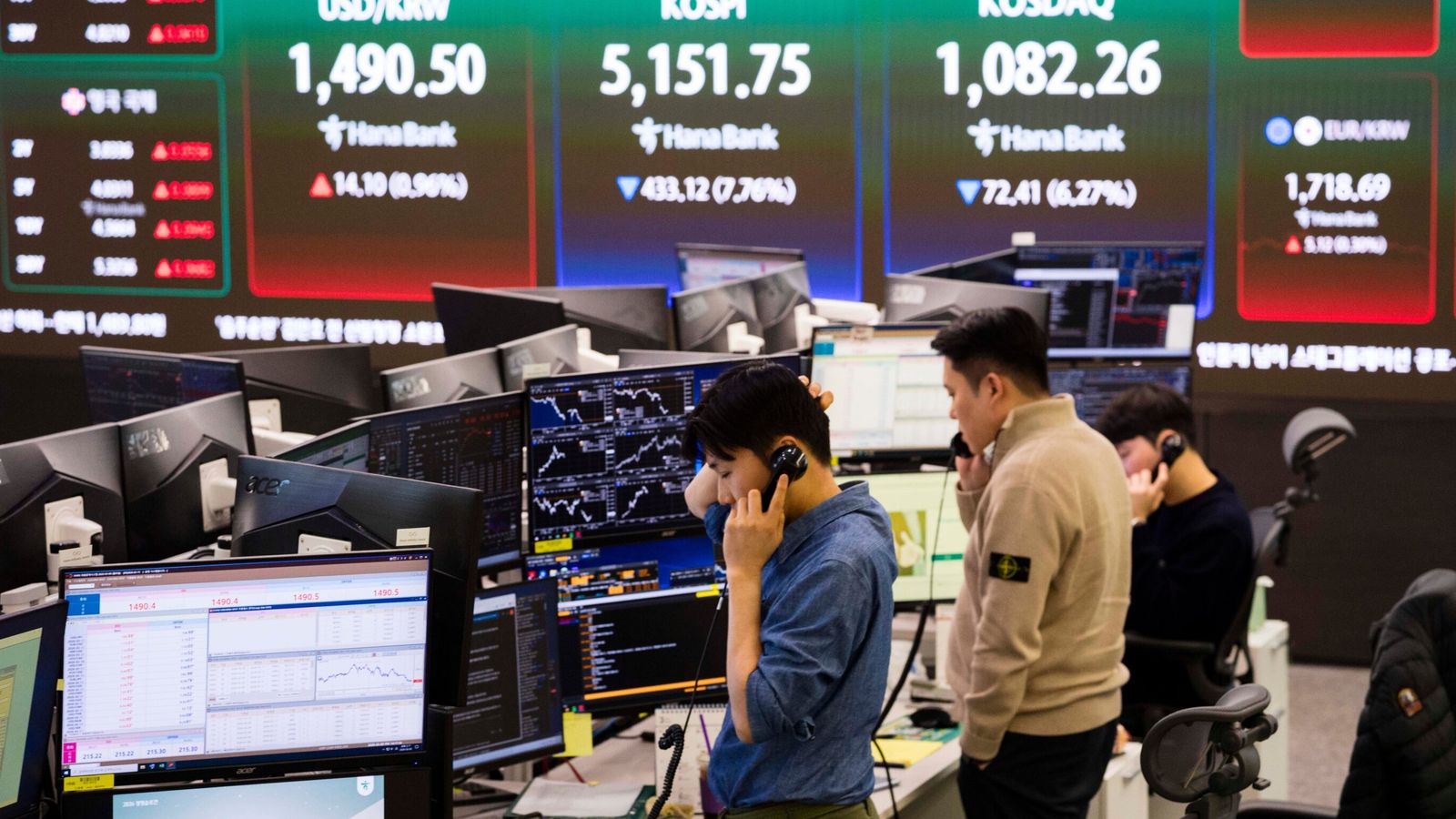
Brent oil jumped >7% to $107.50 following President Trump's remarks and UK wholesale gas rose >6%, driven by month-long shipping disruptions in the Strait of Hormuz that typically carry >20% of global oil/LNG. Sterling slid from $1.33 to $1.32 and from €1.16 to ~€1.15, the FTSE 100 fell 0.6%, and Asian indices (Kospi, Nikkei) dropped 4.5% and 2.3% respectively, signaling broad risk-off flows. The Food and Drink Federation now expects food inflation to reach at least 9% by year-end, underscoring near-term cost-of-living and inflationary pressures.
Energy-market repricing is being driven more by logistics and insurance friction than by an immediate structural production shortfall; longer voyage times, higher war-risk premia and increased use of long-haul routes create a persistent premium on delivered barrels and cargoes that can persist for quarters even after hostilities de‑escalate. That dynamic benefits owners of transport and floating storage capacity, and shifts margin capture toward firms controlling midstream logistics and long‑term SPA holders over marginal spot suppliers that cannot physically deliver.
Macro second‑order effects: higher energy risk premia will keep headline inflation and real rates elevated, forcing central banks into a tighter stance than priced — a classic negative for duration and growth cyclicals and a positive for financials with rate sensitivity. Currency mismatches amplify this: USD‑receiving exporters (energy, some miners) see margin relief while importers and FX‑short sovereigns face balance‑sheet stress and pass‑through to consumers, pushing food & beverage producers toward aggressive price‑action or margin compression depending on pricing power.
Reversal catalysts and timing: expect knee‑jerk moves in days driven by headlines and insurance announcements, meaningful supply normalization on a 2–6 month horizon as tankers resume, and multi‑year realignment if capex is reined in by uncertainty. The consensus is treating this as a short shock; we view the likely outcome as a multi‑quarter reshuffle of value along the hydrocarbon supply chain — an opportunity to own logistics/contracted sellers and hedge cyclical consumer exposure.
AI-powered research, real-time alerts, and portfolio analytics for institutional investors.
Overall Sentiment
strongly negative
Sentiment Score
-0.65
