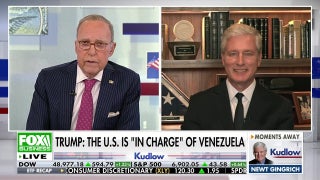
President Trump, invoking an updated Monroe Doctrine, is credited with launching "Operation Absolute Resolve" to remove Venezuela’s Maduro (and his wife) on grounds of narco-terrorism and communist influence; the op-ed frames the action as legally justified and militarily decisive. Venezuela has lost roughly three-quarters of its economy and most of its oil output, and the piece argues the intervention will reverberate across Colombia, Brazil, Cuba and global geopolitics with potential implications for regional stability and energy markets.
Market structure: A successful U.S. kinetic/legal campaign in Venezuela is a clear win for defense contractors (Lockheed Martin LMT, Raytheon RTX, General Dynamics GD) and private security/intel vendors; near-term oil-market winners are crude producers and traders (XOM, CVX, energy trading desks) because geopolitical premium can lift Brent $5–$15/bbl in days. Direct losers are Venezuelan state assets (PDVSA), Venezuela-linked sovereign and corporate debt, and regional high-beta EM equities/FX (ILF, EWZ, COP) which should see >10% volatility. Competitive dynamics favor U.S. service & reconstruction contractors only if sanctions/clearing risk are resolved; absent that, China/Russia can capture reconstruction share.
Risk assessment: Tail risks include asymmetric retaliation (attacks on Gulf shipping or oil infrastructure) that could spike oil >$20/bbl and equity volatility (VIX +50%); tournament risks include rapid policy reversal by courts/Congress or election-driven pullback. Timeframes: immediate (days) = oil/defense vol; short-term (weeks–months) = sanctions, shipping insurance, LATAM capital flight; long-term (1–3 years) = possible incremental Venezuelan output recovery of 0.5–1.0 mbpd conditional on CAPEX & sanction relief. Hidden dependencies: heavy-crude blending capacity, rare earth/logistics bottlenecks, and insurance/finance availability for rebuilds.
Trade implications: Implement tactical longs in defense (LMT, RTX, GD) sized 1–3% each for a 3–6 month horizon targeting +10–25% on sustained geopolitical premium; buy short-dated energy call spreads on XOM/CVX sized 1–2% notional if Brent >$85 (expect $5–10 move). Hedge with 1–2% short ILF or 3-month put on EWZ to capture LatAm downside; buy 1–3% protection via Brent call options or GLD as an oil-inflation hedge. Rotate overweight to Energy & Defense, underweight Latin EM financials and tourism for 3–12 months.
Contrarian angles: Consensus assumes a prolonged conflict -> sustained oil spike and unambiguous U.S. contractor wins; missing is sanction friction: if sanctions remain, majors (XOM/CVX) cannot invest, capping long-term upside and shifting reconstruction profits to non-U.S. players. Historical parallels (Panama 1989, Iraq 2003) show front-loaded defense/energy rallies often mean-revert within 6–12 months; monitor Brent breakpoints ($95 up / $75 down) as trigger points to trim or reverse positions.
AI-powered research, real-time alerts, and portfolio analytics for institutional investors.
Request DemoOverall Sentiment
moderately positive
Sentiment Score
0.50
