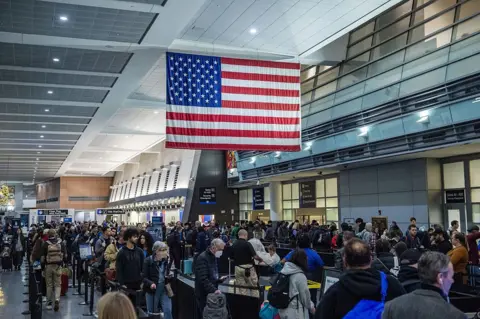
U.S. Transportation Secretary Sean Duffy has launched a DOT campaign urging civility and “dressing with respect” as the FAA forecasts the busiest Thanksgiving travel period in 15 years (more than 52,000 flights on 25 November). The agency cites a 400% increase in in‑flight outbursts since 2019, 13,800 unruly incidents since 2021 and reports that 1 in 5 flight attendants experienced a physical incident, but industry experts and passengers attribute the behavior to systemic operational issues — staffing shortages, cramped economy cabins, delays and ancillary fee business models — and say a manners campaign is unlikely to materially change outcomes. The item is primarily reputational and operational rather than market-moving, but highlights ongoing service, staffing and regulatory risks for airlines that could feed into costs or regulatory scrutiny over time.
Market structure: Robust leisure demand (DOT expecting >52,000 flights on 25 Nov) keeps near-term pricing power for carriers, airports and online travel agencies (OTAs). Winners are scale carriers and gate-rich airports that can extract ancillary fee revenue and recover yields; losers are small/under-capitalized niche carriers and premium-fee dependent services unable to bear higher operating costs. Cross-assets: stronger travel volumes lift high-yield credits of large carriers (tighten spreads), support airport REIT cashflows, and push jet fuel demand modestly higher over months (small upward pressure on futures).
Risk assessment: Tail risks include regulatory intervention (mandatory staffing, higher fines) or major operational shocks (controller strikes, severe winter cancellations) that could erase 1-2 quarters of margin for carriers; probability >10% over 12 months given political pressure. Immediate (days) risk is reputational headline volatility; short-term (weeks) is booking season swings; long-term (quarters) is structural margin pressure from mandated service improvements. Hidden dependency: ancillary-fee models and slim seat density drive passenger frustration — any regulation forcing more legroom or included services materially raises unit costs.
Trade implications: Favor long exposure to travel/transportation ETFs (IYT/XAL) and market leaders with strong balance sheets and diversified networks (LUV, DAL) into Q1 2026; hedge via short small-cap/low-liquidity carriers and buy protective tail puts. Use 1–3 month call spreads into holiday demand and 3–6 month protective put hedges sized to 0.5–1% of portfolio to guard against regulatory shocks.
Contrarian angles: Consensus focuses on civility messaging; investors underprice the likelihood of cost-imposing regulation (staffing mandates, higher fines) which would compress margins by 200–400 bps for lower-margin carriers. Historical parallel: post-crisis regulatory tightening (post-2010s safety rules) produced multi-quarter margin hits but also eliminated weaker competitors — creating consolidation opportunities (M&A) in 12–36 months.
AI-powered research, real-time alerts, and portfolio analytics for institutional investors.
Request DemoOverall Sentiment
neutral
Sentiment Score
0.00
