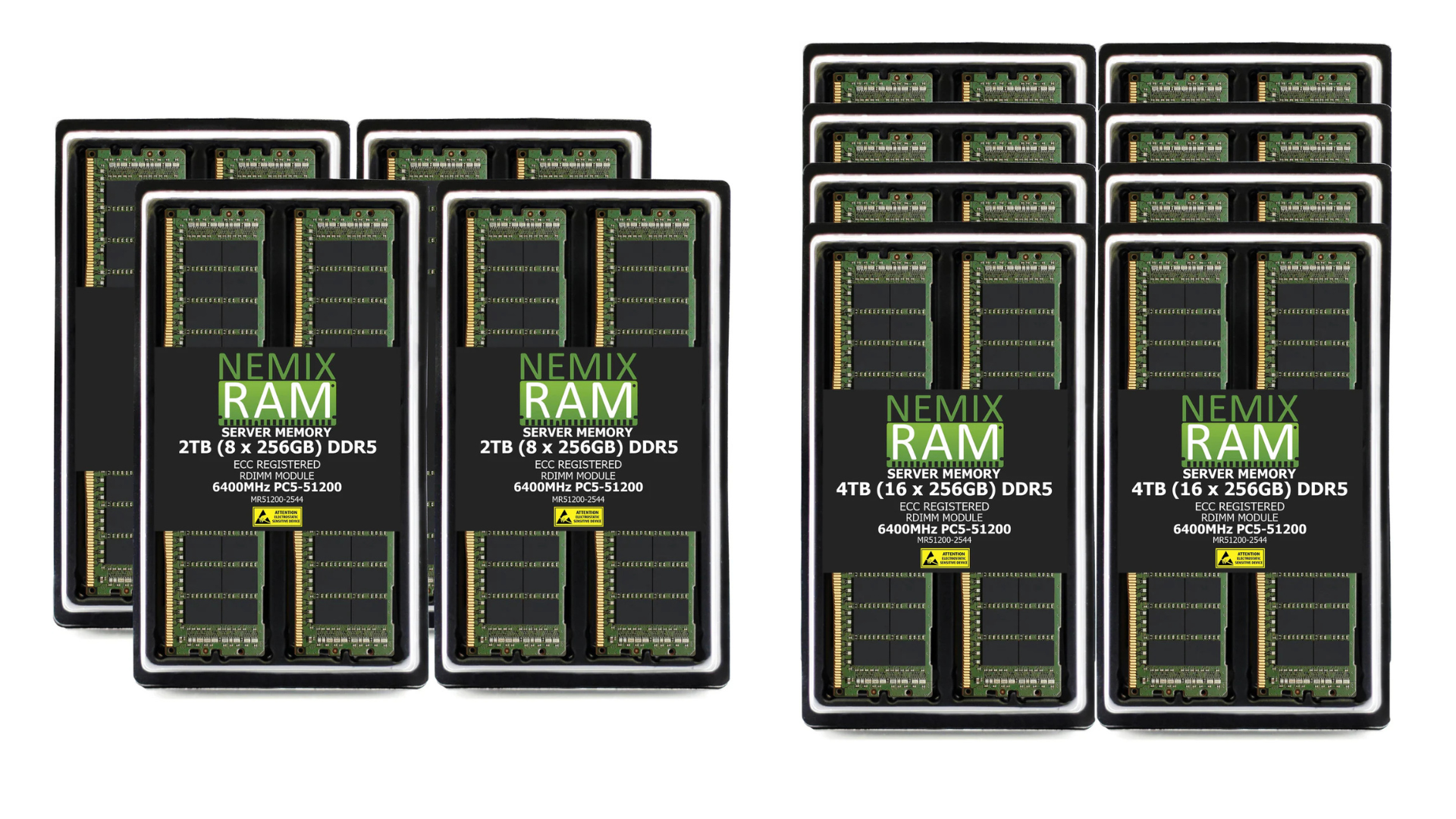
Nemix has listed high-capacity DDR5 ECC RDIMM kits — a 2 TB kit on Amazon for $38,999 and a 4 TB configuration on its website for $76,999.99 — using 256 GB sticks at 6400 MT/s with CL52; prices have risen roughly $6,000 over the past month since first appearing 29 days ago. The article underscores persistent DRAM supply tightness and the large premium for server-grade ECC memory versus DDR4 (Nemix's 2 TB DDR4 kit was ~$13,469), noting lifetime warranty and mixed reviews, which may influence buyer risk assessment but is unlikely to materially move financial markets.
Market structure: The Nemix listing (2TB DDR5 ECC up ~18% month-over-month from $32,997 to $38,999) is a microcosm of tight server DRAM markets where OEM/regulator-grade modules command large premiums. Primary winners: DRAM wafer makers (Micron MU, SK Hynix, Samsung/SSNLF) and certified module integrators; losers: hyperscalers (AMZN/AWS, MSFT, GOOG) and price-sensitive enterprise buyers who face near-term capex inflation. Expect vendor pricing power to persist 3–9 months until visible inventory rebuilds.
Risk assessment: Tail risks include a rapid supply surge from new fabs (price crash >30% within 6–18 months) or geopolitical export controls that further constrain supply and push prices higher; demand shocks (recession) could cut orders by >15% across quarters. Immediate (days–weeks) risk: reseller arbitrage and illiquid ill-performing SKUs; short-term (1–6 months): OEM destocking; long-term (6–24 months): capacity expansion and memory architecture shifts (HBM, compute-in-memory) can structurally reduce commodity DRAM ASPs. Key catalysts to watch: weekly D-RAMeXchange DDR5 indices, MU earnings, ASML tool deliveries, and Taiwan/SK export policy statements.
Trade implications: Tactical: overweight MU (and SK Hynix exposure) for 3–12 months to capture pricing tailwind; size 2–3% portfolio positions with 12-month target +30–40% and stop −15%. Use 3–9 month MU call spreads to limit downside and 2:1 long MU vs short AMZN (0.5–1% notional) as a relative-value hedge against cloud capex squeeze. Rotate overweight semiconductors +1–3% and underweight cloud/enterprise IT hardware spenders by similar amounts until DRAM spot index contracts.
Contrarian angles: Consensus treats reseller price tags as headline inflation; the market may underappreciate that these listings are channels/markup signals, not sustainable ASPs for wafers. If D-RAMeXchange shows falling spot prices for 3 consecutive months or module inventory days >60, the current MU trade becomes crowded and vulnerable to 20–30% mean reversion. Historical DRAM cycles (2016–2019) show rapid reversals; pressure on end-users could accelerate software/memory efficiency investments, capping long-term DRAM growth to mid-single digits annually.
AI-powered research, real-time alerts, and portfolio analytics for institutional investors.
Request DemoOverall Sentiment
mildly negative
Sentiment Score
-0.25
Ticker Sentiment
