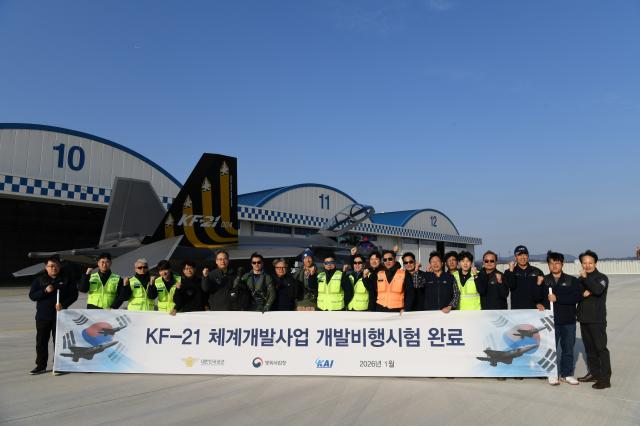
South Korea's DAPA reports the KF-21 fighter completed roughly 1,600 tests over 42 months without accidents, including aerial refueling trials, and conducted its final flight test off Sacheon. Development was accelerated by two months, and mass production deliveries to the Air Force are scheduled for the second half of this year to replace aging F-4 and F-5 fighters, a move expected to strengthen airspace defense and enhance export competitiveness according to DAPA head Noh Ji-man.
Market structure: Domestic aerospace OEMs and tier-1 suppliers in South Korea (KAI, Hanwha Aerospace, LIG Nex1) are direct beneficiaries as mass production begins in H2 2026, lifting near-term revenue visibility and pricing power for avionics and parts suppliers by an estimated 10–25% incremental defense revenue vs 2025 baselines. International primes (Lockheed, BAE) face limited competitive pressure in niche markets where price-performance of a non-stealth 4.5-gen jet matters, but global market share shifts will be gradual (12–36 months) not immediate.
Risk assessment: Tail-risks include US export-control constraints on engines/radars, partner withdrawal or budget retrenchment that could delay deliveries by 6–18 months and wipe 30–50% off consensus near-term cash flows for Korean suppliers. Hidden dependencies: critical foreign subsystems (e.g., F414-derived engines, AESA components) mean geopolitical shifts (US-China tensions) can materially affect supply and exportability; monitor DoD/US Commerce for tech-transfer decisions over next 90 days.
Trade implications: Near-term alpha likely from Korea-focused defense equities and select metals (titanium/aluminum fabricators) into H2 2026; expect modest KRW strength (1–4%) and higher spread on 2–5y Korean sovereign yields if program scales via public capex. Use stock-specific long exposure sized 2–4% of portfolio with 6–12 month time horizon and hedges (options or short global-defense exposure) to manage program/execution risk.
Contrarian: Consensus oversells export upside — real wins require certification and political approvals; conversely, markets may underprice domestic aftermarket/service/upgrade annuity streams that begin when fleets replace F‑4/F‑5 (aftermarket margin 15–25%). Historical parallel: successful artillery/tank programs showed service/upgrade margins compound returns over 3–7 years; if KF-21 secures 2–3 export deals by 2028, upside could be nonlinear.
AI-powered research, real-time alerts, and portfolio analytics for institutional investors.
Request DemoOverall Sentiment
moderately positive
Sentiment Score
0.45
