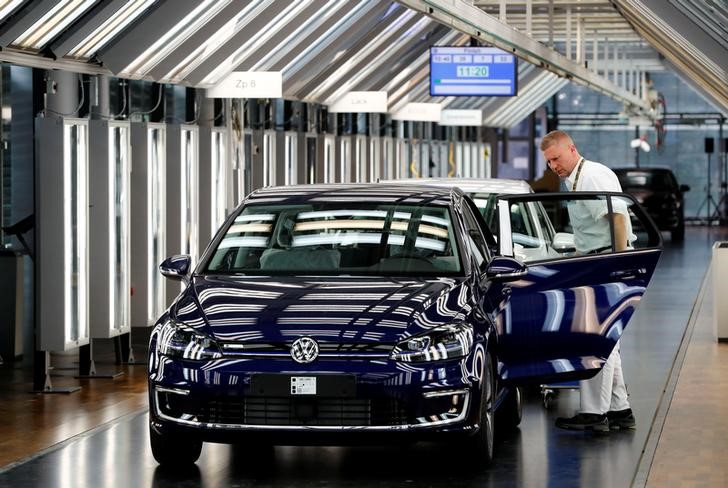
Trump said he will raise U.S. tariffs on European cars and trucks to 25% next week, up from a previously agreed 15%, a move that hit European automakers immediately. Continental fell 4%, while Porsche AG and Mercedes dropped more than 1% each; BMW and Volkswagen were down about 1.3% and 1%, and the STOXX Europe 600 Automobiles & Parts Index lost 0.7%. The European Commission rejected the claim of non-compliance and said it would defend EU interests if Washington proceeds.
The immediate read-through is not just pressure on European OEMs, but a widening dispersion inside the autos complex. The first-order losers are the legacy European assemblers and tier-1 suppliers with high U.S. exposure, but the second-order winners are U.S.-based manufacturers and any OEMs with flexible North American capacity, since tariff differentials can reprice sourcing decisions faster than vehicle platforms can be retooled. This is especially punitive for premium brands because they have less price elasticity: even a small tariff change can force either margin compression or MSRP increases that leak demand.
The more interesting medium-term effect is on the supply chain. If the tariff threat persists into the next 1-2 quarters, expect accelerated pull-forward of parts localization, incremental capex announcements, and weaker orders for transatlantic logistics and specialty components shipped from Europe. That creates a negative feedback loop for European industrials beyond autos, because suppliers with auto-heavy revenue mixes will see volume risk before headline OEM earnings reset fully.
The market may be underpricing policy volatility rather than the tariff level itself. A 25% rate is actionable only if it sticks; however, the administration’s explicit carve-out for U.S. production creates a credible negotiating tool, which means the tradable window may be days to weeks, not months. The contrarian angle is that shares of the most exposed names may be oversold if investors are extrapolating a permanent regime shift, but the right stance is to trade the asymmetry: downside is immediate on headline risk, while any reversal requires visible concessions or a delay in implementation.
GME is largely incidental to the article’s primary macro message; the only investable takeaway is that the news cycle may temporarily support high-beta retail names through increased speculative attention, but there is no durable fundamental linkage from this tariff shock to GameStop. EBAY is essentially unaffected directly, so any move there would be sentiment spillover rather than a fundamental thesis.
AI-powered research, real-time alerts, and portfolio analytics for institutional investors.
Request DemoOverall Sentiment
strongly negative
Sentiment Score
-0.55
Ticker Sentiment
