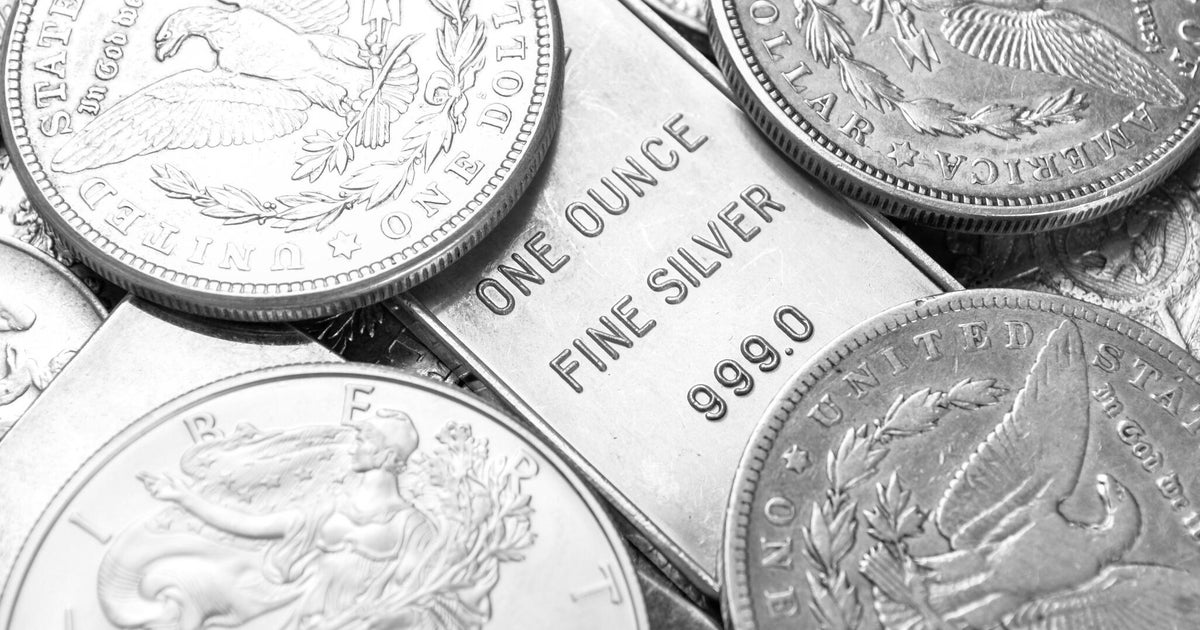
Silver has surged to just over $94/oz (Jan. 22, 2026), decisively breaking prior ceilings amid global supply deficits, physical tightness at exchanges, stronger industrial demand and safe‑haven buying tied to geopolitical tensions and tariff uncertainty. For investors deciding between 1‑oz silver bars and coins, bars offer lower premiums and stacking efficiency (better cost per ounce), while widely recognized coins (e.g., Silver Eagle, Maple Leaf) command higher upfront premiums but superior liquidity and resale in volatile markets; many practitioners recommend a mix and attention to storage, insurance and dealer buyback policies.
Market structure: Elevated silver at ~$94/oz benefits physical dealers, coin mints and miners (SIL, PAAS, HL) via higher revenues and margins; consumers/industrials and ETFs with high premium sensitivity (SLV, SIVR) are pressured by physical tightness and higher bid/ask spreads. Competitive dynamics favor recognizable coin brands and vaulted storage providers—coins command persistent retail premiums while uniform 1-oz bars win on cost-per-ounce for accumulation; expect dealers to widen buyback spreads when spot volatility spikes. Cross-asset: a sustained silver rally will likely depress real yields (safe-haven flows), lift industrial commodity peers (copper, nickel) and raise implied vols in precious-metal options; USD weakness would amplify gains, whereas a surprise Fed hawkish pivot would be the principal contra-driver.
Risk assessment: Tail risks include a sudden liquidity flush (large ETF liquidation or repo strains), regulatory changes on coin sales/taxation, or a rapid industrial demand collapse if global manufacturing slows—each could knock 20–40% off spot. Time horizons: days–weeks dominated by dealer premiums and secondary-market liquidity; months driven by ETF flows and COMEX inventories; quarters–years by mine supply response and substitution in industry. Hidden dependencies include dealer buyback policies, insured storage capacity and concentration of physical holdings in a few vaults; catalysts to watch: COMEX registered inventory moves, ETF net flow delta >5% of outstanding in 30 days, USD/real-rate inflection, and major geopolitical events.
Trade implications: For tactical exposure (weeks–6 months) use liquid ETFs (SLV/SIVR) and 6–9 month call spreads to cap premium cost; for leveraged long-term convexity prefer miners (SIL, PAAS) sized at 1–2% portfolio with 20% stop-loss. Pair trade: long SIL (miners) + short 0.5x SLV to capture miner leverage versus metal if miners underperform by >15% on spreads; entry if miners trade at >25% discount to implied metal exposure historically. Options: buy 6–9 month SLV call spreads at 120%/150% of spot to target 1.5–3x upside with limited downside; sell short-dated covered calls against physical coin-heavy holdings to harvest elevated premiums. Rotate 1–3% from duration into precious metals on break of real yields down 50bp.
Contrarian angles: Consensus assumes continued investor hoarding and industrial demand; missing is dealer/distribution fragility—if buyback liquidity tightens, retail coins may trade at much larger discounts to spot than bars. Reaction may be partially overdone in miners: miners historically lag metal rallies by 3–6 months then re-rate on realized margin expansion, so a patient accumulation in juniors/PAAS-sized positions could outperform. Historical parallels (1979/2011 rallies) show rapid mean reversion after policy or liquidity shifts—set tight risk controls. Unintended consequence: heavy coin demand could push premiums so high that private-sale liquidity collapses, making coins harder to monetize in drawdowns; hence maintain a mix of bars for saleability at scale.
AI-powered research, real-time alerts, and portfolio analytics for institutional investors.
Request DemoOverall Sentiment
mildly positive
Sentiment Score
0.35
