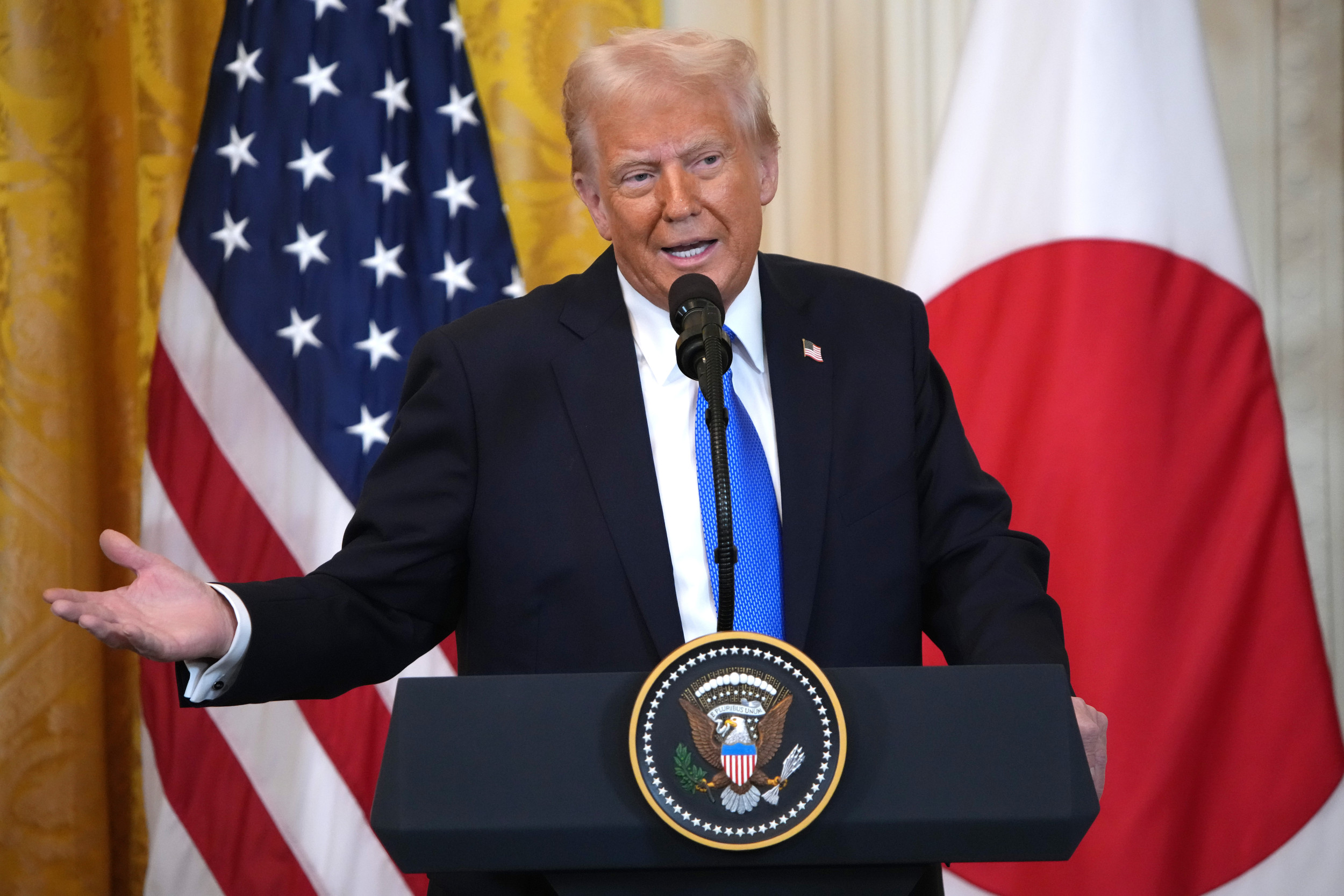
President Trump announced a major trade and investment deal with Japan, featuring a reported $550 billion Japanese investment into the U.S. across key sectors and expanded market access for U.S. agricultural and automotive exports, alongside a 15% tariff on Japanese imports. While presented as complete, the agreement faces scrutiny and requires approval from Japan's Diet, where Prime Minister Ishiba's government recently lost its majority. Despite domestic political challenges and opposition concerns, analysts anticipate the deal will likely pass, as rejection could trigger higher U.S. tariffs, underscoring the delicate balance of geopolitical trade agreements.
A significant trade and investment agreement has been struck between the U.S. and Japan, featuring a $550 billion Japanese investment commitment into U.S. sectors like energy and semiconductors, alongside expanded market access for American agricultural and automotive exports. The deal also imposes a new 15% tariff on Japanese imports. However, the agreement's implementation faces a critical hurdle in the Japanese Diet, where Prime Minister Ishiba's coalition government has recently lost its majority in both chambers. This political weakness creates uncertainty and gives opposition parties, such as the Constitutional Democratic Party (CDP), leverage to scrutinize the deal's benefits for Japan. Despite the mixed reactions and political posturing, a consensus among analysts suggests the Diet is unlikely to reject the agreement. The primary deterrent against rejection is the credible threat of a 25% U.S. tariff on Japanese imports, an alternative that would be significantly more damaging to a Japanese economy already grappling with inflation. This dynamic places the Japanese government in a position with limited negotiating power, making passage of the current deal the most probable, albeit politically difficult, outcome. A specific corporate beneficiary highlighted is Boeing (BA), which is set to receive an order for 100 aircraft as a direct component of the agreement.
AI-powered research, real-time alerts, and portfolio analytics for institutional investors.
Overall Sentiment
mixed
Sentiment Score
0.10
Ticker Sentiment
