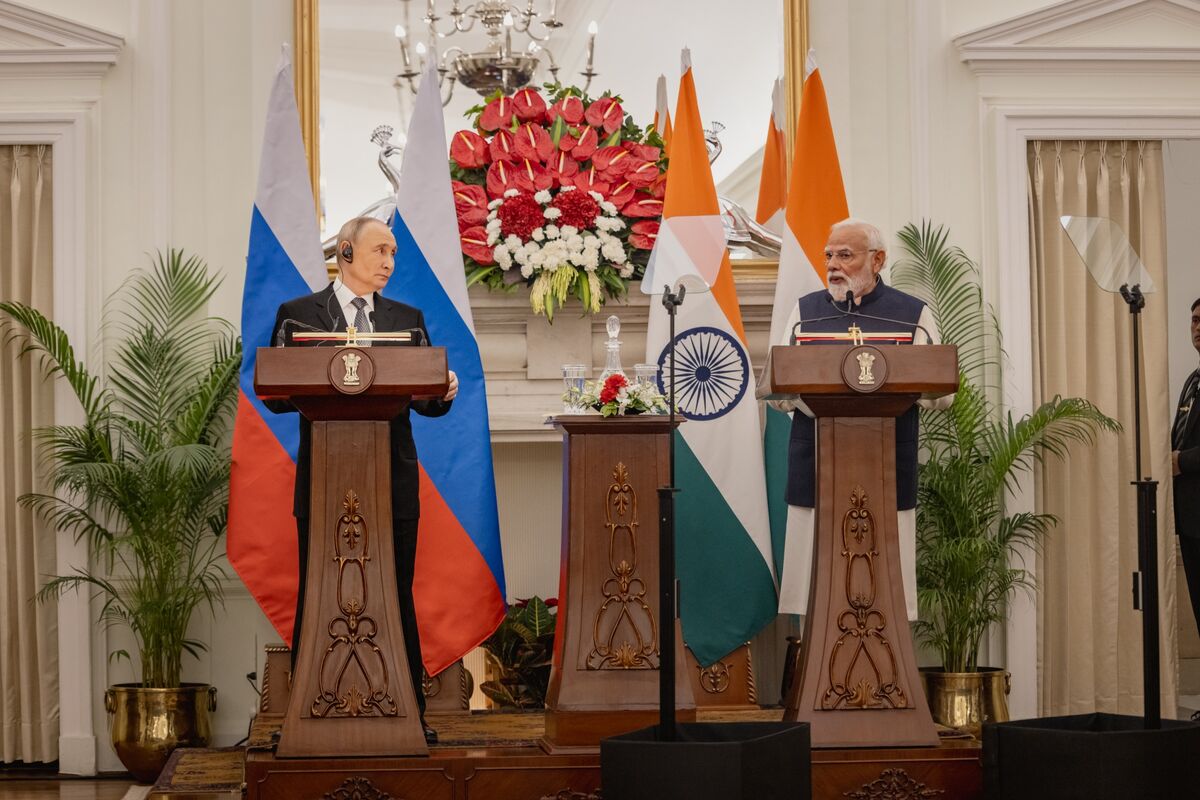
Russian President Vladimir Putin's visit to New Delhi — his first since the 2022 invasion of Ukraine — was met with public warmth, including a hug from Prime Minister Narendra Modi and a joint readout calling the relationship a “special and privileged strategic partnership.” Despite the stage-managed cordiality, the visit underscores a plateauing and gradual fraying of India–Russia ties as New Delhi appears to calibrate its diplomacy post‑2022, a development that could reshape geopolitical alignments and risk profiles for regional trade, defense cooperation and sanction‑exposure assessments.
Market structure: A slow Indian drift away from unconditional Russian dependence favors Western defense primes (Lockheed LMT, Raytheon RTX) and Indian private manufacturers while compressing Russian exporters' pricing power for arms and high-tech goods. Energy flows remain the wild card — Russia will likely sustain discounted oil sales to preserve volumes, pressuring benchmarks but leaving India bargaining leverage to extract better terms; expect modest margin pressure on Russian commodity producers over 6–24 months.
Risk assessment: Immediate (days) risk is limited market reaction; short-term (weeks–months) risks include volatility around procurement announcements and FX swings (INR/RUB); long-term (2–5 years) is strategic supply-chain realignment away from Russia. Tail risks: an escalation that forces India into a hard diplomatic choice (low probability, high impact), or Russia weaponizing energy/metal discounts to retain market share, which could swing commodity prices by >10%.
Trade implications: Favor reallocation into India exposure and Western defense primes while hedging commodity and RUB exposure. Competitive dynamics suggest Western suppliers can win multi-year contracts worth low single-digit billions annually to India — a realistic trigger for stock re-rating within 6–18 months. Use options to express asymmetric upside around discrete contract award windows.
Contrarian angles: Consensus assumes a rapid India-West pivot; miss is that India will remain transactional — continuing Russian buys at steeper discounts while buying Western tech selectively. That supports a phased, not binary, investment approach: price in 5–15% idiosyncratic moves rather than outright regime change.
AI-powered research, real-time alerts, and portfolio analytics for institutional investors.
Request DemoOverall Sentiment
mildly negative
Sentiment Score
-0.25
