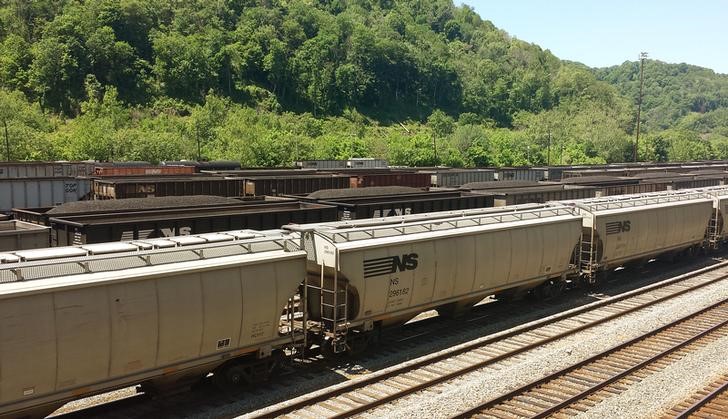
The Association of American Railroads sued New Jersey in federal court to block Senate Bill 3389, challenging five provisions including mandatory two-person crews and a state-run wayside detector program and seeking an injunction. The complaint names NJ Attorney General Jennifer Davenport and Transportation Commissioner Priya Jain and represents Class I carriers (BNSF, Canadian National, CPKC, CSX, Norfolk Southern, Union Pacific), noting CSX and Norfolk Southern operate in New Jersey.
This is a classic federal-preemption conflict: the immediate market move should be driven by litigation timing and the probability of a preliminary injunction rather than the substantive merits of each statutory line-item. Expect headline-driven intraday volatility for carriers with local exposure; the court will likely resolve injunctive relief within weeks-to-months, while any definitive Supreme Court resolution would be a multi-year outcome.
If the state law were enforced, mechanics create two paths to visible margin erosion: recurring labor run-rate (adding a crew headcount on qualifying movements) and an upfront capex/maintenance program for wayside detectors and inspections. Back-of-envelope: adding one crew-equivalent on key manifests can raise incremental unit labor cost by high-single digits to low-teens percentage on those moves, implying 50–150bp pressure to industry operating ratios concentrated on affected corridors rather than a uniform hit across the network.
Second-order winners are rails with scale, diversified geographies and stronger operating flexibility — they can reroute traffic, absorb capex centrally or push costs through contractual pricing; smaller-market or regionally concentrated operators are structurally more exposed. Key catalysts: preliminary injunction motion, state appellate filing, DOT involvement or federal rulemaking, and imitation legislation from other states — each unfolds on its own cadence and will reprice idiosyncratic exposure in 0–90 days (court) and 6–24 months (legislative contagion).
AI-powered research, real-time alerts, and portfolio analytics for institutional investors.
Overall Sentiment
neutral
Sentiment Score
0.00
Ticker Sentiment
