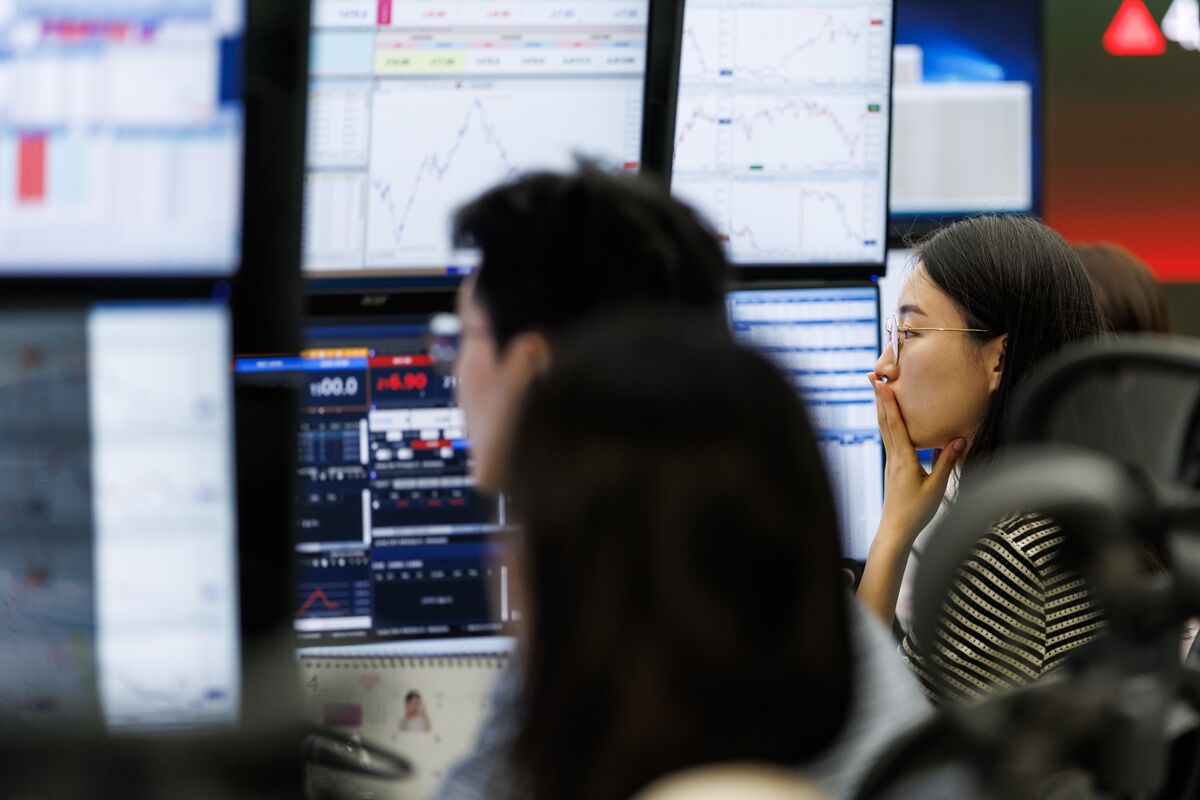
The Kospi fell about 5% after briefly touching the 8,000 milestone, as overseas investors continued to cut exposure to South Korean equities. Foreign selling was concentrated in technology shares, with the Kospi tech subgauge seeing net outflows exceeding $2.5 billion. The move points to a sharp risk-off reversal in one of the world’s hottest stock markets.
This looks less like a clean mean-reversion flush and more like a positioning unwind in a crowded growth factor. When a market makes a round-number breakout and then instantly gives it back on foreign selling, the first-order damage is to domestic confidence; the second-order damage is to any local balance-sheet leverage and momentum systematic exposure that had been chasing the tape. The tech pocket is the weak link because it is the most globally owned, most valuation-sensitive, and most vulnerable to de-grossing when volatility spikes. The next-order beneficiary is not necessarily another equity market, but cash and duration. If global allocators are de-risking Korean tech, some of that capital can rotate into U.S. megacap AI/semis or into high-quality defensives where earnings visibility is less dependent on multiple expansion. Within Korea, exporters with hard-currency revenues and lower narrative intensity should outperform the domestic platform/AI names if the selloff broadens beyond a tactical shakeout. Catalyst risk is asymmetric over the next 1-3 weeks: if foreign outflows persist for several sessions, local momentum traders and leveraged vehicles can force a second leg lower, especially if the benchmark loses recent breakout support. Over 1-3 months, the reversal case is simple: stabilization in the U.S. rates/FX backdrop or a pause in overseas selling could quickly restore the bull case because the fundamental story has not been invalidated, only the ownership base has become fragile. The market is probably underpricing how quickly crowded winners can mean-revert once foreigners stop providing marginal demand. The contrarian read is that this may be a positioning event more than a macro regime shift. A 5% air pocket after an index milestone often flushes weak longs and resets sentiment, which can create a better entry if outflows slow and the currency remains stable. The biggest mistake would be extrapolating one concentrated foreign selloff into a full cycle top; the better tell is whether breadth deteriorates beyond tech and whether local institutions step in to absorb supply.
AI-powered research, real-time alerts, and portfolio analytics for institutional investors.
Request DemoOverall Sentiment
strongly negative
Sentiment Score
-0.55
