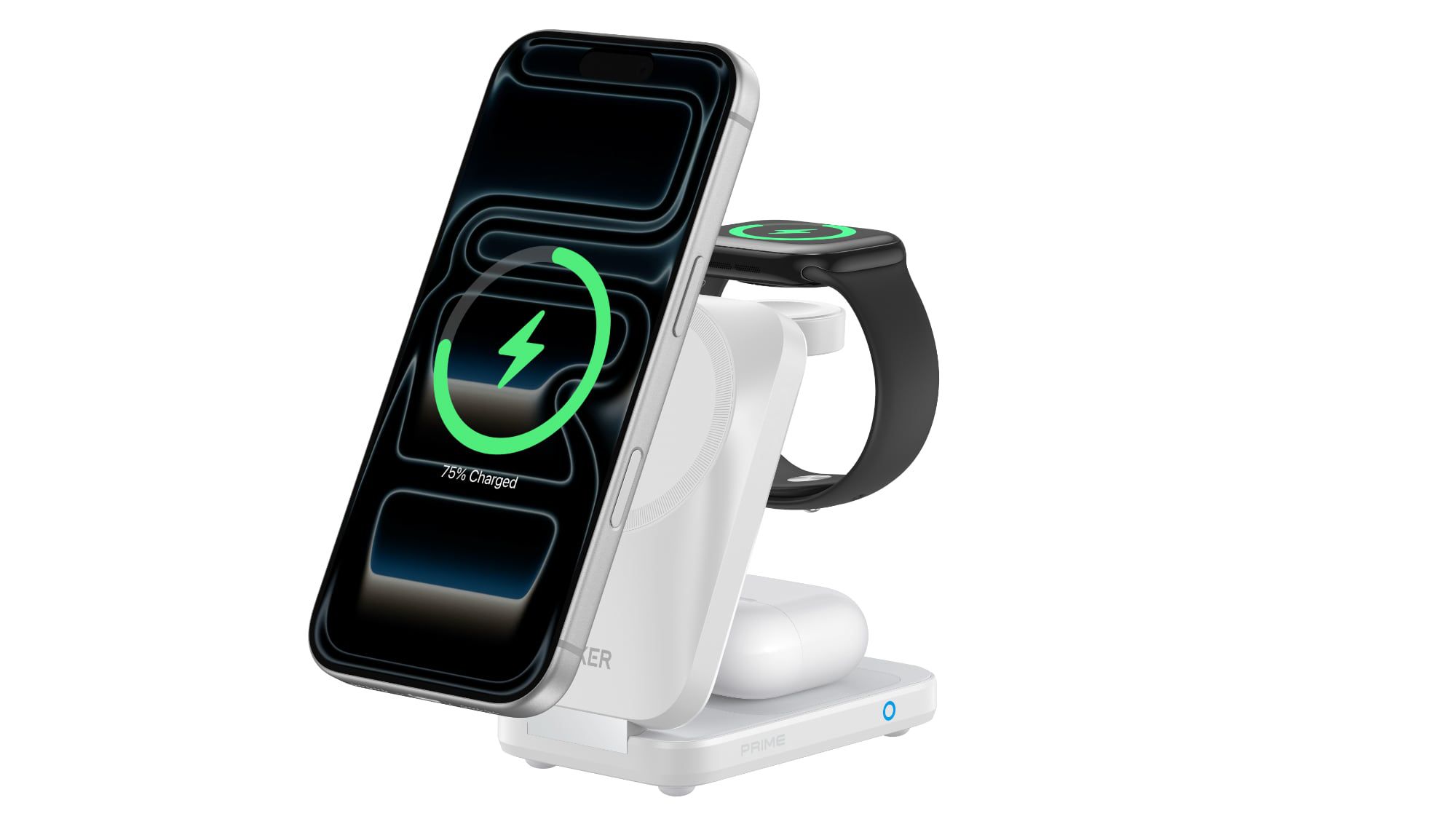
Anker unveiled a slate of new charging products slated to roll out starting in January, including a $150 Prime Wireless Charging Station (25W Qi2, charges iPhone 17 to 80% in 55 minutes, foldable with airflow cooling), a $40 45W Nano Charger (smart power delivery, claims 9°C lower battery temperature), a $70 Nano Power Strip (six AC outlets, two USB‑C with 70W max), and a $150 Nano Docking Station (available now; removable hub, 3x displays up to 4K, 100W charging, 10Gb/s). The Nano Charger and Power Strip launch in late January, the Prime Wireless Station in Q1 2026, and the Dock is already on Anker’s site — signaling incremental product revenue opportunities focused on Apple-centric fast charging and travel/desk use cases.
Market structure: Anker’s new Nano line (price points $40/$70/$150) intensifies low-cost, feature-rich competition in the charger/docking market and will most directly benefit large power-IC suppliers and scale OEMs while pressuring small accessory specialists. Expect downwards pressure on third‑party accessory ASPs of ~3–7% over 6–12 months as MagSafe/Qi2-capable, cooled fast chargers and multi-port docks become table stakes; AAPL benefits modestly from ecosystem stickiness and higher accessory spend.
Risk assessment: Tail risks include an Apple policy shift (tighter certification/licensing or proprietary changes) or safety recalls that could wipe out accessory demand — low probability but >$1bn ecosystem impact if enacted within 12 months. Immediate (days) impact is muted; short-term (weeks–months) watch for inventory build-up at retailers and channel pricing; long-term (quarters–years) is tech adoption of Qi2/GaN and consolidation of accessory makers.
Trade implications: Direct plays are AAPL (ecosystem beneficiary) and semiconductor power-IC names (TI, STM) supplying USB-C/GaN controllers; short or underweight small accessory specialists (e.g., ZAGG) exposed to price competition. Use options to express asymmetric views: near-term call spreads on AAPL into Q1–Q2 2026 for accessory tailwinds and 9–12 month LEAP calls on TI/STM for semiconductor structural gains; harvest premium with iron condors if IV collapses post-product news.
Contrarian angles: Consensus underestimates margin pressure on small accessory players and overestimates immediate macro impact on Apple hardware sales; the real alpha is in power-ICs and controller vendors whose volume could rise 10–20% within 12 months. Watch for unintended consequence: aggressive pricing by Anker could accelerate consolidation and margin re‑rating of incumbents, creating buyout targets rather than permanent losers.
AI-powered research, real-time alerts, and portfolio analytics for institutional investors.
Request DemoOverall Sentiment
mildly positive
Sentiment Score
0.25
Ticker Sentiment
